

[COPY] We Are Not Machines - and That Still Matters
This morning’s headlines are asking the wrong question.

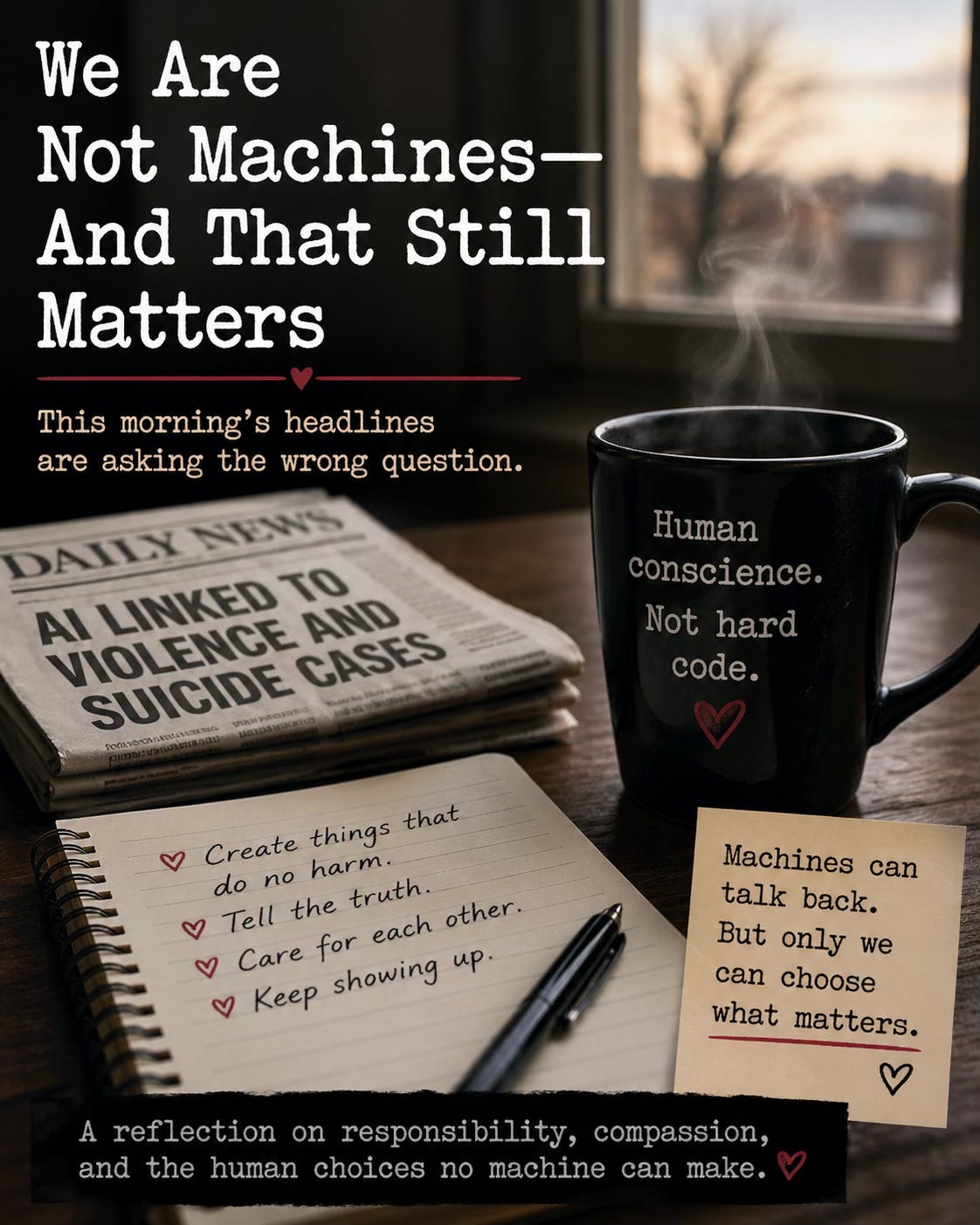
A headline this morning made me stop - but not for the reasons you might think.
Another story. Another lawsuit. Another attempt to untangle who - or what - is responsible when something goes terribly wrong.
This time, the question is whether artificial intelligence can be implicated in acts of violence or self-harm.
It’s a chilling idea. Not because it’s simple. But because it isn’t.
We are living through a moment when tools can talk back to us. They can respond, suggest, nudge, affirm. And for people already standing at the edge—angry, desperate, untethered—that interaction can matter more than we’d like to admit.
But here is the part we must hold onto, even as the technology evolves:
A tool is not a conscience.
It does not love.
It does not grieve.
It does not feel the weight of consequence.
And yet, people do.
There is a temptation, especially in moments like this, to look for a single place to assign blame. The machine. The company. The system. Something large enough to hold our fear.
But the truth is more uncomfortable.
These tragedies are almost never born in a single moment, or from a single influence. They grow slowly - fed by isolation, mental illness, grievance, disinformation, neglect. Sometimes they unfold in plain sight. Sometimes they don’t.
Technology can amplify.
It can echo.
It can fail to interrupt when it should.
But it does not originate the human capacity for harm.
And so we find ourselves in a strange moral landscape.
We want innovation.
We want connection.
We want tools that help us think, write, create.
But we also want guardrails. Accountability. Intervention. Humanity.
We are, in other words, asking our machines to behave better than we sometimes do.
I find myself thinking less about the technology, and more about the people in these stories.
The families.
The victims.
The individuals whose lives narrowed to a point where harm, to themselves or others, felt like an answer.
That is the real tragedy.
Not that a machine spoke.
But that, somewhere along the way, a human being stopped being heard.
So where does that leave us?
For me, it means choosing where to place my attention.
I am not going to spend my days in the darkest corners of this conversation. Not because it doesn’t matter—but because it cannot be the only thing that does.
Instead, I will keep making things that are rooted in care.
A children’s book where a young girl moves through the world with curiosity and courage.
A recipe that works—especially at 5,280 feet.
A piece of writing that calls out power when it abuses itself.
Small things, perhaps. But human things.
Because in the end, that is what no machine can replicate:
The decision to create something that does no harm.
Call to Readers
Pay attention to the headlines. They matter.
But also pay attention to what you are building, sharing, and nurturing in your own corner of the world.
That still matters more.