

Everyone Knows. Nobody Says It.
The politics of pretending, from golden idols to naked emperors.

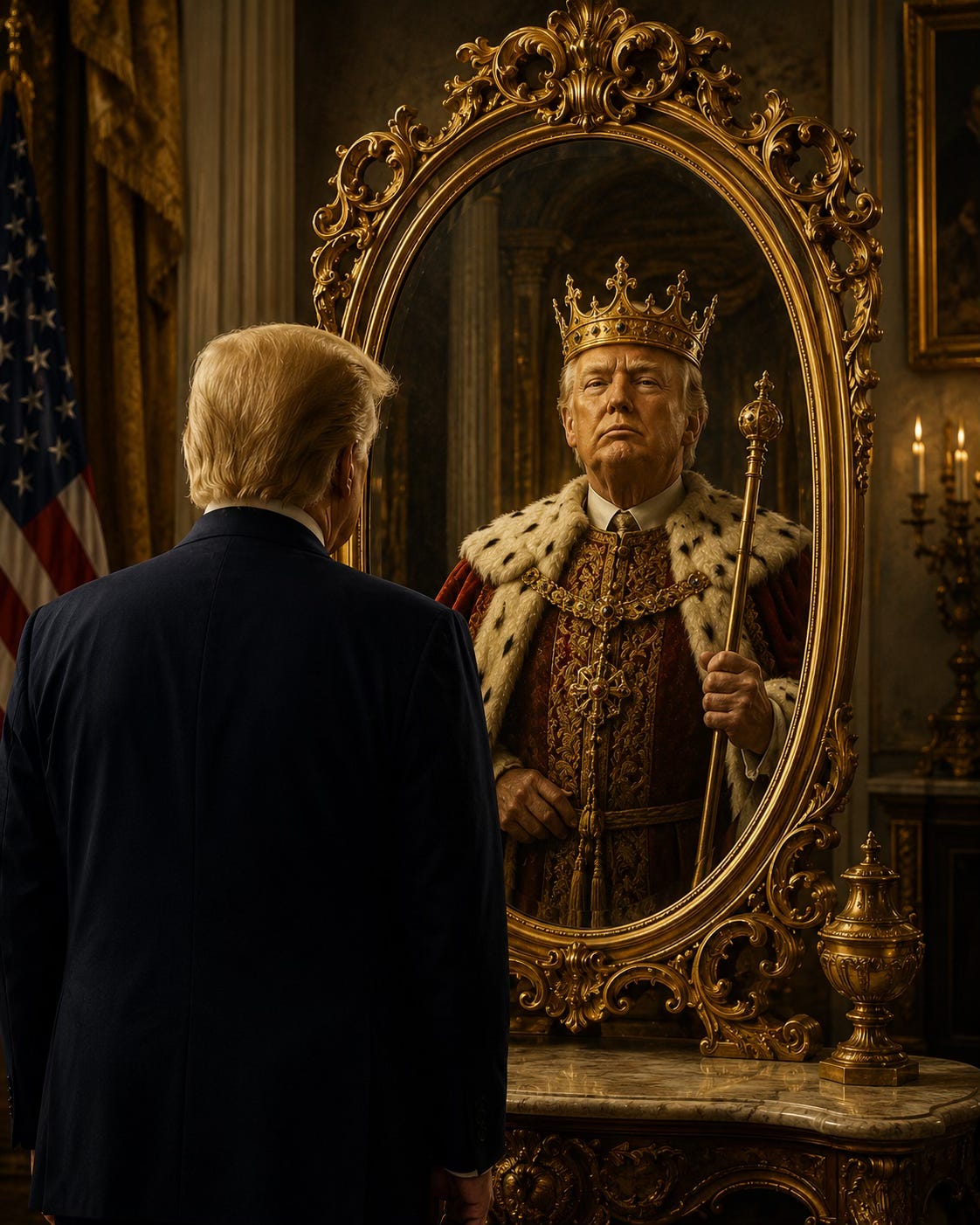
America feels fictional right now.
Not politically divided. Not merely dysfunctional.
Fictional.
As though we have wandered into some bizarre mashup of biblical warning, fairy tale, and political satire—except the consequences are real.
We have a president who openly worships wealth, spectacle, and personal glorification.
A political party that increasingly behaves like a royal court.
Institutions designed to constrain power acting as though constraint itself is optional.
And a public watching the procession, wondering if they are the only ones seeing what is plainly in front of them.
A biblical warning, a fairy tale, and a modern psychological phenomenon explain this moment better than most cable news panels.
The Golden Calf.
The Emperor’s New Clothes.
Collective illusion.
THE GOLDEN CALF
Trump’s obsession with gold has never been subtle.
Long before politics, he proudly displayed his family in the infamous Trump Tower penthouse, a monument to gilded excess that looks less like sophisticated wealth and more like a casino designed by a czar with no editor.” 1
Mar-a-Lago continued the theme: gold trim, gold fixtures, gold ornamentation, theatrical opulence masquerading as taste. 2
Now that aesthetic has crept into the presidency itself.
The White House, historically symbolic of democratic stewardship and institutional continuity, increasingly risks becoming another extension of Trump’s personal branding fantasy. 3
This is not merely décor.
It is symbolism.
Gold has long represented monarchy, conquest, untouchable wealth, and divine entitlement.
Kings project splendor.
Democracies are supposed to project service.
Trump has never seemed to understand the difference.
Or perhaps he understands it perfectly.
What makes the Golden Calf story so unsettling is not the gold itself.
It is the collective act of creation.
The people pooled their own wealth, forged the idol themselves, and then convinced themselves it was worthy of worship. 4
That symbolism feels painfully current.
Some authoritarian figures seize power by force.
Others are assembled—piece by piece—by people who project onto them strength, certainty, vengeance, protection, and success, until the idol takes on a life of its own.
Too much of modern political culture has embraced a grotesque equation:
Rich equals successful.
Successful equals competent.
Competent equals worthy of power.
Never mind ethics.
Never mind public service.
Never mind character.
Just look at the gold.
THE EMPEROR’S NEW CLOTHES
If the Golden Calf explains the worship, Hans Christian Andersen explains the performance.
In The Emperor’s New Clothes, a vain ruler obsessed with appearance is duped by con artists who claim they can weave magical garments visible only to the intelligent and competent. 5
No one sees anything.
But no one wants to appear foolish.
So ministers pretend.
Officials pretend.
The emperor pretends.
The public pretends.
Everyone participates in a lie because everyone assumes everyone else believes it.
Sound familiar?
A president openly embraces royal imagery, even circulating memes depicting himself as a king. 6
Conflicts of interest that would once have triggered bipartisan outrage are shrugged off.
Self-enrichment is discussed as though it were merely unconventional politics.
Cabinet appointments sometimes feel like parody casting.
And yet much of the political establishment proceeds as though this is perfectly normal governance.
Why?
Because authoritarian systems thrive on performance.
Speaking obvious truths becomes risky.
Silence becomes self-protection.
Compliance becomes career management.
And soon the absurd becomes normalized simply because enough people act as though it already is.
COLLECTIVE ILLUSION: THE MODERN EXPLANATION
Political psychologists have a name for this. 7
Collective illusion.
Or pluralistic ignorance.
It describes a situation in which individuals privately reject a belief but publicly conform because they assume everyone else accepts it.
In simpler terms:
No one believes.
But everyone believes that everyone else believes.
That is how entire institutions become detached from reality.
A lawmaker privately calls something dangerous but votes yes.
An official privately expresses alarm but publicly defends the indefensible.
A media outlet normalizes increasingly abnormal behavior in the name of neutrality.
Citizens wonder whether they are overreacting because surely someone in power would stop this if it were truly alarming.
This is how democracies slide into authoritarianism.
Not always through dramatic coups.
Sometimes through accumulated public pretending.
THE ROYAL COURT
Of course, not everyone is pretending.
Some participants are true believers.
Others are opportunists.
And some have fully embraced the role of court entertainers—actively defending, flattering, distracting, and amplifying the spectacle.
Some courtiers are frightened.
Some are calculating.
Some are simply intoxicated by proximity to power.
But the effect is the same.
The procession continues.
THE CHILD IN THE CROWD
Andersen’s story ends when a child says the obvious:
The emperor is wearing nothing at all.
That moment matters because truth often begins not with institutional courage, but with someone refusing to participate in the lie.
The danger in America right now is not simply corruption.
Corruption is sadly familiar.
The danger is normalization.
The gradual social pressure to accept what would once have been unthinkable.
To treat grotesque self-dealing as savvy.
To confuse gaudiness with strength.
To mistake domination for leadership.
To applaud the parade because everyone else appears to be applauding.
America does not need more courtiers.
It needs more children—more citizens—willing to say what they see.
And perhaps, occasionally, a foreign leader who sees the pageantry for exactly what it is.
Xi Jinping may have understood the symbolism better than Trump did. 8
After Trump admired the roses at Zhongnanhai, Xi reportedly promised to send rose seeds for the White House Rose Garden—an almost too-perfect gift for a man who transformed part of that historic garden into a Mar-a-Lago-style hardscape. 9
Whether Xi intended the irony or not, the symbolism was unmistakable:
The emperor who loves gold was handed seeds.
Not flattery.
Not another gilded tribute.
Seeds.
Something alive.
Something rooted.
Something that requires patience, care, and stewardship.
In other words, everything Trump’s golden presidency is not.
Footnotes:
Mar-a-Lago Photo Gallery. https://www.maralagoclub.com/wedding-event-photo-gallery
Business Insider, “Before-and-After Photos Show Changes Trump’s White House Decor,” April 1, 2026. https://www.businessinsider.com/donald-trump-white-house-decor-oval-office-photos-2025-4
Bible Gateway, Exodus 32:2–4, NIV. https://www.biblegateway.com/passage/?search=Exodus+32&version=NIV
Politico, “‘LONG LIVE THE KING’: Trump increasingly embraces monarchical imagery,” February 19, 2025. https://www.politico.com/news/2025/02/19/donald-trump-king-imagery-021013
Frontiers in Social Psychology, “A century of pluralistic ignorance: what we have learned about its origins, forms, and consequences,” 2023. https://www.frontiersin.org/journals/social-psychology/articles/10.3389/frsps.2023.1260896/full
New York Post, “Xi promises to send Trump sweet gift for the White House during tour of his 1500-acre compound,” May 15, 2026. https://nypost.com/2026/05/15/us-news/xi-vows-to-send-seeds-after-trump-admires-his-most-beautiful-roses/
Reuters Pictures, “Trump hosts dinner in newly renovated Rose Garden,” September 7, 2025. https://www.reuters.com/pictures/trump-hosts-dinner-newly-renovated-rose-garden-2025-09-07/
Well done, Jeri! The ending description of the kind of character it takes to plant, grow and nurture seeds was spot on. I really enjoyed this!