

Gilead Doesn’t Arrive All at Once
As Language and Power Converge, Our Freedom Is at Risk

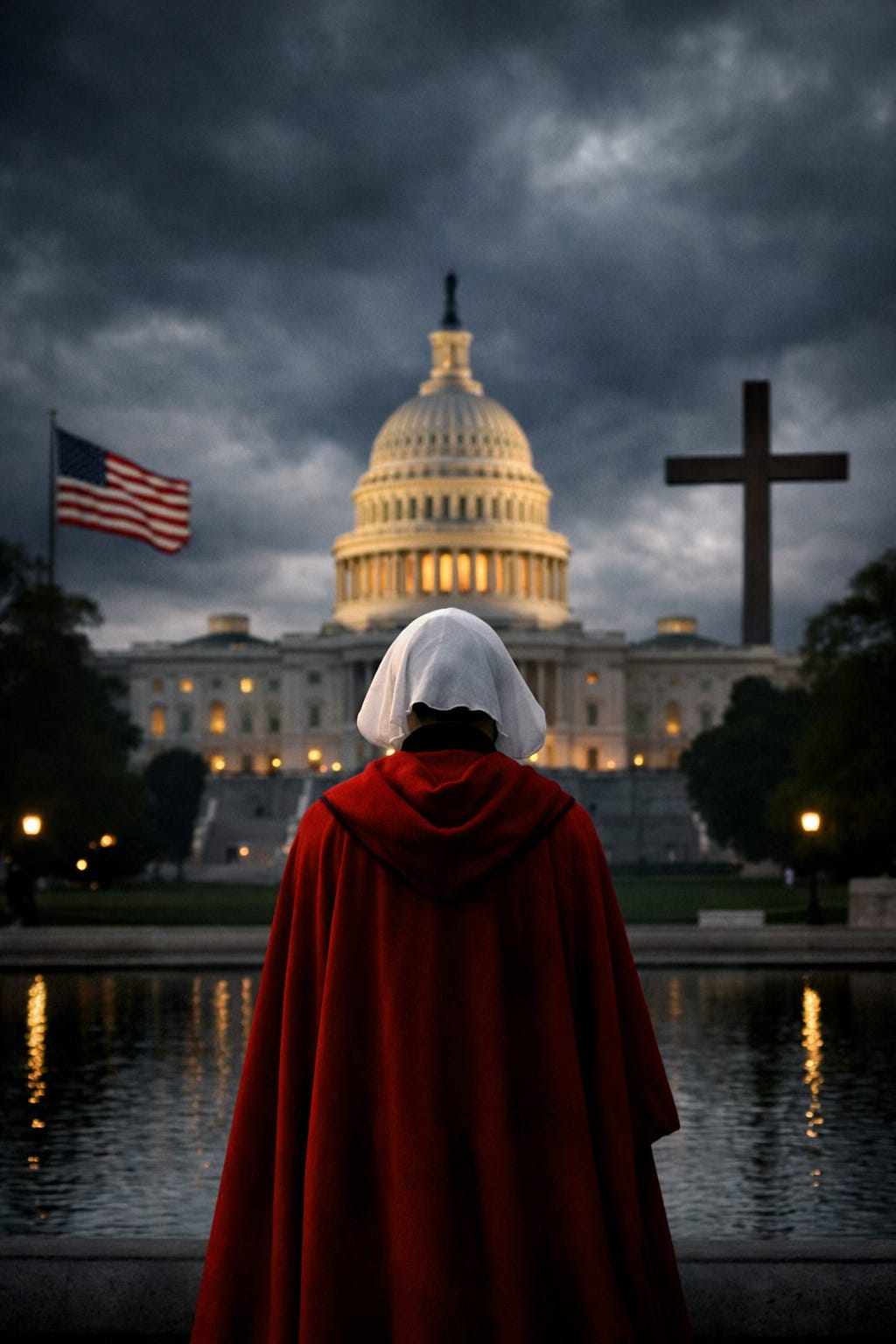
A familiar phrase has been echoing more frequently in American political life: “doing God’s work.”
It is offered as reassurance. As conviction. As justification.
But it raises a deeper question - one that is less often asked: What happens when political authority begins to describe itself, not just as accountable to voters, but as aligned with divine will?
That question sits at the center of Margaret Atwood’s novel, The Handmaid’s Tale. And it is what makes the novel feel less like distant dystopia and more like a framework for understanding how certain systems evolve.
Gilead did not begin with handmaids. It began with language - about authority, morality, and purpose.
In The Handmaid’s Tale, the Republic of Gilead is a theonomy: a system in which law is derived from religious interpretation and enforced by the state. It is also explicitly patriarchal and totalitarian. Rights are not universal. They are assigned based on gender, status, and perceived moral value.
But what makes the novel enduring is not its extremity. It is its sequence.
Gilead emerges through steps that, taken individually, can be framed as orderly, necessary, even moral. Constitutional norms are suspended. Institutions are reshaped. Language shifts. Authority consolidates. Only later does the full structure become visible.
Atwood’s warning is not that societies leap into oppression. It is that they can move toward it while still believing themselves justified.
The United States is not Gilead.
There are still elections. Courts still function. Civil society remains active. Competing religious and secular perspectives continue to shape public debate. But, acknowledging that reality does not end the inquiry. It sharpens it.
Because the more relevant question is not whether we are there. It is whether certain developments reflect similar structural tendencies.
And some of them do.
Start with the use of religious language in governance.
When political leaders such as House Speaker Mike Johnson invoke faith in the context of governance, or figures like Secretary of Defense Pete Hegseth frame political and military action as aligned with divine purpose, the issue is not personal belief. It is the elevation of policy into moral certainty.
If a policy is aligned with God’s will, disagreement is no longer just political; it risks being cast as moral failure. That is a subtle but significant shift. It moves authority away from democratic negotiation and toward moral finality.
In Gilead, that shift is complete. Law is not debated. It is declared.
Language, however, is only part of the shift. Practice matters too.
In recent years, religious expression has moved beyond political rhetoric and into visible practices of governance itself.
During the Trump administration, that shift has become more explicit. A White House Faith Office has been established, alongside faith-based initiatives and evangelical gatherings in which participants “lay hands” on political leaders in prayer. Structured prayer practices within government institutions, along with longstanding events such as the National Prayer Breakfast, reflect a growing normalization of explicitly religious activity within the government.
The issue is not whether public officials hold religious beliefs. Of course they do. The issue is whether those beliefs are being translated into the functions of government in ways the Constitution was designed to prevent.
The First Amendment does not prohibit religion in public life. It prohibits the establishment of religion by the state - a boundary the founders considered essential to both religious freedom and democratic governance.
That boundary was not an afterthought. It was designed to guard against systems in which political and religious authority are fused, and dissent can be punished as disobedience to both.
When organized religious practices become embedded within government, when leaders are affirmed through ritual, and policy is justified as divinely sanctioned - the line the First Amendment draws is not blurred. It is erased.
The question is no longer whether individuals believe. It is whether the state itself is beginning to operate with a preferred religious framework.
What is different is the visibility and institutional framing of these practices, not simply as personal devotion, but as part of the governing environment.
When prayer moves from private observance to organized, leadership-centered ritual within state institutions, it raises a different kind of question: Is religion being expressed within government—or is it being integrated into how government legitimizes itself?
In The Handmaid’s Tale, ritual is not incidental. It is structural. Ceremonies reinforce hierarchy. Public acts of devotion signal alignment. Religious practice is not separate from governance. It is one of the mechanisms through which governance is maintained.
The comparison here is not equivalence.
The United States does not mandate religious observance, nor does it formally require participation. But when organized religious practices are embedded within political institutions, they can become signals of belonging. In a system where loyalty to leadership is expected, participation is not compelled; yet non-participation becomes increasingly difficult to separate from dissent.
Consider the reshaping of education.
Efforts to redirect public funds toward private religious schools are often framed in terms of parental choice. But they also raise a structural question: is the goal pluralism, or the expansion of a preferred worldview through state-supported channels?
In The Handmaid’s Tale, education is not neutral. It is a tool of reinforcement. It teaches hierarchy, obedience, and the legitimacy of the system itself.
Modern policy is not equivalent. But it exists on a continuum that asks the same question: who shapes the worldview of the next generation, and with what authority?
Look also at gender.
Policies affecting reproductive rights, healthcare access, and legal autonomy are often debated as discrete issues. But taken together, they can signal a broader redefinition of women’s role within the legal and social order.
Gilead enforces that role with brutal clarity. Contemporary policy does not approach that level of control. But it does reflect an ongoing struggle over whether rights are fully individual or partially conditional. That tension is not theoretical. It is unfolding in real time.
Then there is the question of democratic participation.
Restrictions on voting access, shifts in election administration, and efforts to concentrate executive power are frequently justified as procedural or protective measures. But historically, the erosion of participation is one of the earliest indicators of systemic change.
Gilead did not eliminate democracy overnight. It narrowed it, constrained it, and ultimately replaced it. The parallel here is not outcome. It is trajectory.
None of this means the United States is becoming a theocracy.
But it does mean that elements associated with theonomy - religious justification of law, moral framing of authority, and the elevation of a particular worldview - are increasingly present in political discourse.
The distinction that matters is this:
Religious influence in politics is not new. It is part of American history.
Religious authority as the basis of law and policy is something else entirely.
One is compatible with pluralism.
The other is not.
The power of The Handmaid’s Tale lies in its refusal to present Gilead as an abrupt transformation. It is a system that develops through language, policy, and incremental shifts in legitimacy.
It begins when leaders claim not just to govern, but to interpret a higher will.
It deepens when institutions align around that claim.
It solidifies when dissent is no longer treated as disagreement, but as deviance.
We are not living in Gilead.
But we are living in a moment where fundamental questions about authority, rights, and the role of religion in law are being actively contested.
And those questions deserve to be examined with clarity, not dismissed with slogans. Because Gilead did not arrive fully formed.
It was built, step by step, through language, policy, and the steady consolidation of authority - by people who believed they were restoring order, defending morality, and, above all, doing what they understood to be right.
The question is not whether that story is repeating itself. The question is whether we recognize the language - and the direction it points - before it becomes the structure we live under.
The language a society accepts is often the clearest signal of the future it is willing to build.
Sources
All claims in this piece are drawn from publicly available primary documents and mainstream reporting, including White House materials on faith-based initiatives; Associated Press, Reuters, and New York Times coverage of religious rhetoric and practice in governance; U.S. Supreme Court decisions including Dobbs v. Jackson Women’s Health Organization; Brennan Center analyses of voting law changes; and academic research on Christian nationalism and theonomy.
Said an international religious figure from Chicago: "Nope. Your hands are full of blood".
And, paraphrasing from "The Untouchables": "That's the Chicago way". These gangsters need to be called out like this. Like you're doing here. So, thanks.
Tim Long, Just Up the Hill from Lock 15