


I apologize that it’s been longer than usual since Lindsay or I published a new SubStack. After successfully dodging COVID for years, we finally caught it, and the past two weeks have been a blur of exhaustion and recovery.
In that short time away, the administration’s immigration crackdown has escalated again - more aggressive tactics, more fear, and more open defiance of basic legal restraint. Across the country, communities report masked, armed federal officers conducting enforcement operations that feel designed to intimidate as much as to arrest. And the widening net has not stopped at undocumented immigrants: it has swept up refugees, visa holders, and U.S. citizens.
Minneapolis became the most stark example. In January, two U.S. citizens - Renée Good 1 and Alex Pretti - were shot and killed by federal immigration agents during the surge of enforcement and the protests that followed. 2 In both cases, the administration’s public claims about what happened were quickly contested by bystander video and subsequent reporting. The pattern is familiar: violence first, narrative control second, accountability last. 3
While I was convalescing, a friend sent me a link to a document preserved in the Internet Archive. (Thank you, Cyn.) It is a War Department “Army Talk” Orientation Fact Sheet- Number 64 -issued March 24, 1945, titled simply: FASCISM! 4
Reading it felt like stepping into a time machine - only to discover we have circled back to the same warnings.
One paragraph in particular could be describing the conduct and ambitions we are watching now:
“Fascism is government by the few and for the few. The objective is seizure and control of the economic, political, social, and cultural life of the state… They permit no civil liberties, no equality before the law. They make their own rules and change them as they choose.”
That is the part too many Americans still struggle to name: fascism is not only a symbol or a slogan. It is a method. It is the systematic conversion of government into a private weapon—used to punish enemies, reward allies, and silence resistance.
The pamphlet also describes how fascism comes to power: not as a sudden coup that everyone recognizes, but through propaganda, deception, and the recruitment of insecure people—backed quietly by powerful economic interests. That is not ancient history. In the United States, the movement that won the 2024 election took power in January 2025 with a blueprint already written - Project 2025 - built to concentrate authority, dismantle constraints, and replace a rights-based democracy with a loyalty-based regime.
In our case, the coalition is not subtle. The Heritage Foundation assembled a governing network of ideological operatives and wealthy backers, including powerful figures across technology, media, and fossil fuels. A second pillar is Christian nationalism: a movement that supplies religious justification for political domination through ideas like “Manifest Destiny” and the Seven Mountains doctrine. Project 2025’s program is not simply conservative policy. It is a redesign of the state to make resistance futile. 5
The regime’s consolidation has been accelerated in two decisive ways.
First, the Supreme Court’s embrace of sweeping presidential power has helped normalize the idea that the executive can act beyond meaningful restraint—an architecture that mirrors the “unitary executive” vision central to Project 2025. Second, a compliant Congress has too often surrendered its own constitutional role: tolerating lawlessness, confirming unqualified loyalists, and behaving as if oversight is optional. Russell Vought’s return to lead the Office of Management and Budget is not a bureaucratic footnote; it is the installation of a key Project 2025 architect in one of the most powerful levers of government. Meanwhile, Stephen Miller’s central role in immigration enforcement signals exactly what the administration views as both a target and a test case.
At this point, it helps to be precise about what we are seeing, and what we must prove. If you want to use the strongest language without giving critics an easy escape hatch, apply a simple four-part test: Target (who is being removed), Territory (from where), Intent (what officials say they want, and what the policies reliably produce), and Coercion (what makes the “choice” non-voluntary). Under that framework, the administration’s actions fit “forced removal,” even when cloaked in the vocabulary of “law enforcement.” The intent is removal; the target is immigrants (and, in practice, disproportionately non-white immigrants); and the coercive machinery is detention, raids, transfers, fear, and intimidation at scale. What remains to be argued - case by case, with evidence - is when “forced removal” crosses into the international concept of “ethnic cleansing,” which turns on the goal of making particular places demographically “clean” through intimidation and expulsion, or even massacre.
History matters here because fascist regimes do not always “ignore” the law in a crude sense. They do something more insidious: they rewrite the law, hollow it out, invent emergency authorities, or create special systems where normal rights no longer apply. Nazi Germany and Fascist Italy both turned scapegoating into state policy, then turned policy into removal, and removal into mass killing. Imperial Japan built its own machinery of terror, forced labor, and group-targeted violence across occupied Asia. Different systems, same logic: the state defines a target group as a threat, then claims that any measure used against that group is “necessary.”
That is why Minneapolis matters so much. When U.S. citizens can be killed in the public streets during immigration operations - and when official accounts are contradicted by video and reporting - the question is no longer whether the Bill of Rights is being “tested.” The question is whether it will be enforced at all.
And immigration enforcement is not the only arena where the rule of law is being treated as optional.
At the Pentagon, Secretary Pete Hegseth imposed new reporting rules so restrictive that most major outlets rejected them and surrendered their credentials rather than sign away independent journalism. That is not “normal friction” between government and press. It is a demand for control - an authoritarian insistence that the public may only know what the state approves. 6
Beyond our borders, the administration’s expanding use of force has raised even more serious alarms. Families have filed suit over a Caribbean boat strike campaign they call unlawful - an operation that, according to reporting and legal filings, has killed large numbers of people, including fishermen, and includes alleged incidents in which survivors were struck after an initial attack. 7 Reporting has also raised questions about aircraft used in these strikes being painted to resemble civilian planes—an allegation that, if true, would represent an extraordinary breach of basic norms. 8
And then there is Venezuela. Congress has already tried - and failed - to rein in presidential war powers related to military actions there, an effort that only exists because lawmakers themselves are warning that the administration is using force without constitutionally required authorization. 9 Legal analysis has been blunt: whatever name the administration gives it, regime-decapitation by bombing is war, and the power to initiate war belongs to Congress. 10
This is why that 1945 War Department pamphlet hits so hard. Its authors were not speculating. They had watched fascism destroy legal systems from the inside. They understood that the point is not merely to defeat a foreign enemy - it is to recognize the method before it takes root at home.
The pamphlet’s final question was simple: “How to stop it?”
Its answer is even simpler: by making democracy work. By actively defending civil rights, resisting discrimination and prejudice, insisting on equality before the law, and cooperating to preserve peace and security. The authors warned that freedom cannot be maintained in isolation. If we allow prejudice to strip anyone of democratic rights, all democracy is threatened.
Those values shaped the postwar world: alliances, human rights norms, the civil rights movement, expanded voting access, and the long - unfinished - work of making democracy real for everyone. That is the America this regime is trying to end. Constitutional limits replaced by loyalty; independent institutions replaced by obedient ones; rights replaced by permissions.
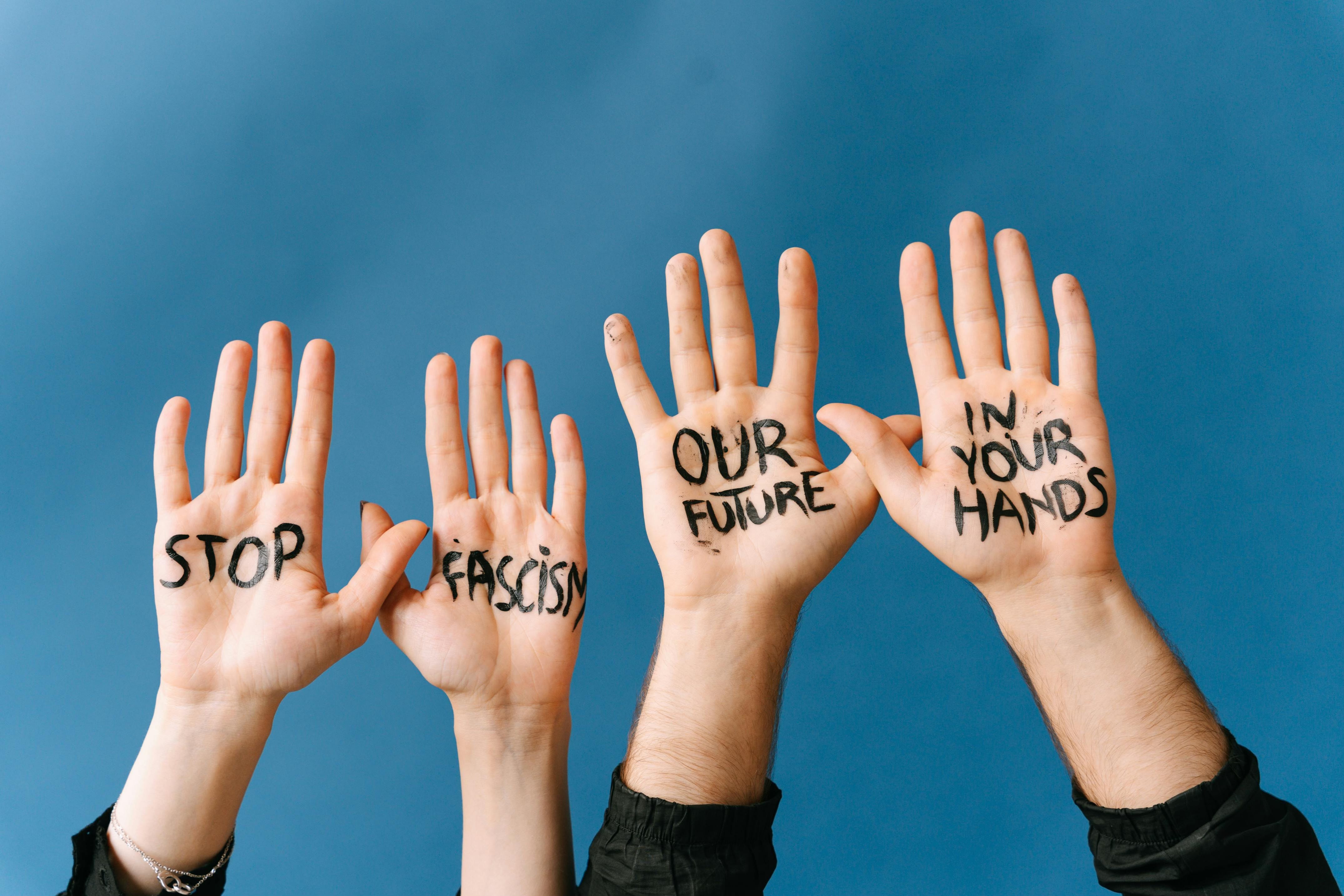
For those of us who warned - when Project 2025 was posted online, long before the election - that this was the plan, the speed of implementation is horrifying but not surprising. The time for euphemisms is over. Fascism is not a distant threat or an academic debate. It is a governing method -and it is here.
So here is the call to action: name what is happening, out loud, without apology. Document it. Support legal defense organizations and local mutual aid networks protecting immigrants and targeted communities. Demand that elected officials use every tool they still have—hearings, subpoenas, funding constraints, state and local non-cooperation policies that are lawful, and litigation that forces constitutional review. Show up in public, peacefully and persistently. Attend a No Kings protest on March 28. Authoritarianism depends on silence, isolation, and exhaustion. We defeat it by staying visible, connected, and unafraid.