

The Art of the War: What Trump Actually Wants From Iran
The Islamabad talks just collapsed. The pattern, however, has been clear for years.

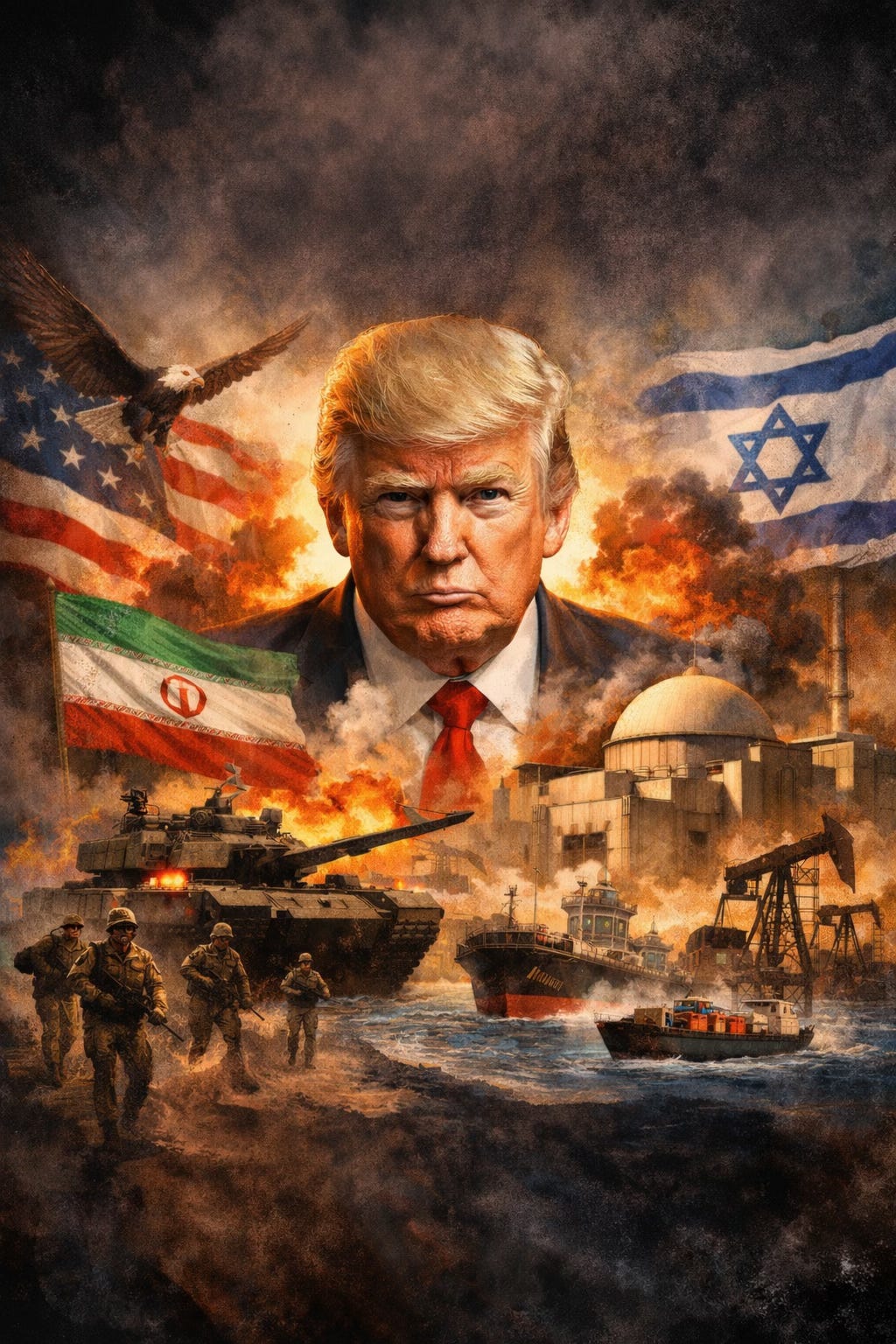
After more than 21 hours of marathon negotiations in Islamabad, Pakistan, Vice President JD Vance boarded Air Force Two on Sunday and told reporters the obvious: no deal. “I think that’s bad news for Iran much more than it’s bad news for the United States,” he said.
A telling statement from a man who just failed to end a war his administration started.
I’ve been watching Donald Trump’s relationship with Iran for years. Long before he became president the first time. Long before he blew up the JCPOA. Long before the February strikes that killed Iran’s Supreme Leader and plunged the region into open war. And I’ve come to a conclusion that I think the record now fully supports: Trump doesn’t want a deal with Iran. He wants Iran.
Let me show my work.
The Pattern: Trump Doesn’t Negotiate, He Acquires
Before we can understand what’s happening in the Iran conflict, we have to understand how Trump thinks about geography and power. This is not, at heart, a foreign policy thinker. This is a real estate developer who became president.
Trump has publicly floated “acquiring” Greenland, going so far as to send his son there and refuse to rule out military action. He has repeatedly spoken about “taking” the Panama Canal. He effectively coerced Panama and Denmark with economic and military threats. He proposed “owning” Gaza, displacing its population and turning it into a “Riviera of the Middle East.” He has used tariffs as a cudgel to extract economic submission from allies and adversaries alike.
The pattern is consistent and commercial: identify a valuable piece of geography or resource, manufacture or exploit a crisis, apply overwhelming pressure - financial, military, diplomatic - and then position the United States (and by extension, himself) as the indispensable power over what follows.
Venezuela is the clearest proof of concept, and the case that makes the Iran argument hardest to dismiss. Venezuela sits on the largest proven oil reserves in the world. Under Trump, the United States recognized a parallel government, imposed crushing sanctions specifically designed to strangle oil revenues, and manipulated Chevron’s operating license there as a lever of economic coercion. The logic was never subtle: comply with American terms, or watch your oil economy collapse. There was no serious diplomatic framework, no multilateral process, no interest in Venezuelan institutions or democratic development for its own sake. There was oil, and there was pressure. When critics argue that Trump’s Iran policy is really about nuclear weapons or counterterrorism, Venezuela is the answer, because Venezuela has neither, and it got the same treatment.
The common variable is resources and submission, not security.
Iran fits this template almost perfectly, and raises the stakes considerably higher.
What Iran Has That Trump Wants
Let’s be direct about what’s at stake geographically and economically.
Iran sits on the fourth-largest proven oil reserves in the world and the second-largest natural gas reserves. It controls - or can choke - the Strait of Hormuz, through which roughly 20% of the world’s oil supply passes. Its closure since late February has already sent global energy prices into turmoil.
Iran is also positioned at the intersection of Central Asia, the Persian Gulf, and the broader Middle East - a strategic location that major powers have competed over for centuries.
Trump himself has never been shy about his view that the United States should extract economic value from military engagement. “To the victor belong the spoils” is not a metaphor for him; he said it literally about Iraq’s oil. The same logic, I would argue, underlies his approach to Iran.
This is inference, but it is inference with a paper trail. Trump’s public statements about oil, his transactional view of military force, and his history of leveraging conflict to extract economic concessions make it reasonable to conclude that Iran’s resources are a motivating factor - not a peripheral one.
The JCPOA: Destroying What Was Working
To understand Trump’s Iran policy, you have to start with 2018, when he did something that had no strategic logic unless you were trying to destabilize rather than contain.
The Joint Comprehensive Plan of Action - negotiated by the Obama administration, the European Union, Russia, China, France, Germany, and the UK - was not a perfect agreement. But it was a working one. International monitors from the IAEA verified Iran’s compliance. Uranium enrichment was curtailed. The path to a nuclear weapon had been blocked, at least temporarily.
Trump withdrew the United States from the agreement in May 2018 - one of his first major foreign policy acts of his first term. He replaced it with what his administration called “maximum pressure”: the reimposition of crippling sanctions designed to force Iran to the table on Trump’s terms.
The effect was predictable and has been widely documented: Iran began enriching uranium again, steadily increasing its stockpile and the purity of its enrichment toward weapons-grade levels. The crisis that Trump inherited - a contained nuclear standoff - became the active weapons-development emergency that now requires a war to address.
If the goal was preventing a nuclear Iran, withdrawing from JCPOA was a catastrophic goal. If the goal was manufacturing a more acute crisis that would justify more dramatic action - that’s a different story.The February Strikes: Intimidation as Strategy
On February 28, 2026, the United States and Israel launched a coordinated air campaign against Iran. Supreme Leader Ali Khamenei was killed, along with the Minister of Defense, the head of the Revolutionary Guard, and numerous other senior officials and military commanders.
This was unprecedented. The United States killed a head of state.
The stated rationale was Iran’s nuclear program and its support for regional proxies. But the timing and scale also fit a pattern of using overwhelming force - not to conclude a conflict but to break a government’s will to create conditions for submission rather than negotiation.
It didn’t work. Iran responded with missile strikes against Israel and US bases throughout the region, closed the Strait of Hormuz, and demonstrated that decapitating its leadership did not end its institutional capacity to fight. The war has now stretched past six weeks with no end in sight, at least 1,700 Iranian civilians are dead, including hundreds of children, and global energy markets are in disarray.
Trump, meanwhile, lurched from one contradictory message to another. On March 6, he demanded “UNCONDITIONAL SURRENDER.” On March 9, he falsely declared, “The war is very complete, pretty much.” By March 30, he was threatening to destroy Iran’s power plants, oil wells, and desalination plants. During that same period, he also claimed Iran had “agreed to most of our demands” - a claim Iran flatly disputed.
This is not the communication pattern of an administration trying to close a deal. It is the pattern of one trying to intimidate.
The Negotiating Team: What the Choices Reveal
Judge a negotiation by who you send to it.
Iran arrived in Islamabad with a delegation of more than 70 people, led by Foreign Minister Abbas Araghchi, an experienced career diplomat, and Parliament Speaker Mohammad Bagher Ghalibaf, a former Revolutionary Guard commander who understands both the military and political dimensions of the conflict. These are people who have spent their careers navigating the intersection of Iranian domestic politics, international law, and strategic competition.
The United States sent JD Vance, a politician with limited diplomatic experience who warned Iran not to “play us” before the talks began. Alongside him: Steve Witkoff, a real estate developer who serves as Trump’s special envoy, and Jared Kushner, Trump’s son-in-law and another real estate figure who has previously used back-channel diplomacy in the Middle East for purposes that critics argue served his personal business interests as much as American policy goals. Veteran diplomats have publicly criticized this team composition, noting that the administration “has leaned on trusted allies with business ties instead of experienced foreign policy professionals.”
What does it mean to send a real estate developer and a hedge fund manager to negotiate the end of a war with a nation of 90 million people?
It means you’re not primarily thinking about what kind of country Iran should be. You’re thinking about what kind of deal you can extract, who controls what assets, and who gets to be the victor.
The Alignment With Israel: Whose War Is This?
Any honest analysis of Trump’s Iran policy has to grapple with Israel.
Trump’s alignment with Benjamin Netanyahu’s government is deep, personal, and well-documented. His first term included moving the US embassy to Jerusalem, recognizing Israeli sovereignty over the Golan Heights, and withdrawing from JCPOA - all major Israeli government priorities. The Abraham Accords, his signature foreign policy achievement, were designed in part to build a regional coalition that isolated Iran.
The February strikes were a joint US-Israeli operation. Netanyahu has publicly called the destruction of Iran’s nuclear program and military infrastructure a generational achievement. He has also made clear, repeatedly, that he will not allow a ceasefire to constrain Israeli operations in Lebanon against Hezbollah, even when doing so directly undermined the fragile truce that Pakistani mediators had constructed.
This creates a dynamic worth naming plainly: the United States is fighting a war in which one of the key operational decisions - whether to extend the ceasefire to Lebanon - is being made by a foreign government whose interests do not perfectly align with American ones. Netanyahu didn’t mention the Islamabad talks in a major public address while they were happening. He said only that “the battle is not yet over.”
Speculation with supporting evidence: it is reasonable to ask whether the United States is conducting a war primarily in American interests, or whether the Trump-Netanyahu alignment has created conditions in which Israel’s desire to permanently neutralize Iran - and specifically Hezbollah - is driving decisions that American diplomats are then left to justify. US intelligence assessments have reportedly raised doubts about Netanyahu’s own claims about how much damage has actually been done to Iran’s nuclear program and military.
The Racist and Anti-Muslim Dimension
This is the part of the analysis where I want to be careful, not because the evidence is thin, but because the claim deserves precision.
Trump’s rhetoric about Muslim-majority countries has a long record. The Muslim travel ban was one of his first acts in office during his first term. His language about Middle Eastern countries has consistently othered and dehumanized. His approach to Gaza - proposing to displace its population, describe it as “a demolition site,” and rebuild it as a resort - treats Arab Muslim lives as obstacles rather than as the lives of people with political rights and human dignity.
In the case of Iran, the framing has been similarly dehumanizing. Trump wrote, mid-negotiation, that the only reason Iranian officials were “alive today is to negotiate” - as though their right to exist was contingent on their usefulness to him. He threatened to send Iran “back to the Stone Ages.” He has shown no detectable interest in the 1,700 Iranian civilians, including 254 children, killed since the war began.
I am not claiming Trump has articulated a policy of eliminating Muslims. I am claiming the consistent pattern - who gets dehumanized in his rhetoric, which lives he shows no interest in counting, which populations he proposes to displace or control - reflects something more than strategic calculation. It reflects a worldview in which certain people’s lives count less, and in which Muslim-majority populations are consistently in that category.
What Iran Keeps Getting Right
One of the underreported stories of this conflict is how consistently Iran has outmaneuvered the United States diplomatically.
Iran has successfully internationalized the conflict, drawing in Pakistan as a credible mediator and enlisting Egypt, Turkey, Saudi Arabia, and China as supporting actors. It presented a structured 10-point negotiating framework with clear demands. It held the Strait of Hormuz - the world’s most critical oil chokepoint - as genuine leverage, not merely a threat. It managed to make nuclear enrichment the central issue, not regime change, which forced the US to negotiate on terms that stopped well short of the “unconditional surrender” Trump had demanded in March.
The two sides entered Islamabad with, as one reporter observed, “vastly different approaches” - the US looking for a quick resolution, Iran negotiating with the patience of an institution that has been under sanctions for 45 years and knows how to wait.
This is not a coincidence. This is what happens when you send a real estate developer to negotiate with a civilization.
What Comes Next
Vance left Islamabad on Sunday, threatening a “full naval blockade” of Iran. Trump has threatened to destroy Iran’s power plants, oil wells, and desalination plants. The ceasefire is now in doubt.
None of this looks like the endgame of a president who wants a genuine diplomatic resolution. It looks like the behavior of a president who wanted terms that amount to submission, didn’t get them, and is now escalating again.
The question that I cannot answer with certainty, but that the pattern of evidence increasingly raises, is whether there is any version of a negotiated settlement that Trump would actually accept, or whether the goal was never a deal.
Because if it was never a deal, then everything else - the JCPOA withdrawal, the strikes, the negotiating team, the maximalist demands, the threats - snaps into focus.
Not strategic incoherence. Strategic clarity about an objective that could not be stated publicly.
Control. Extraction. Dominance.
The art of the deal, applied to a nation of 90 million people.
The question is not whether Trump can close a deal.
The question is how much of the world he is willing to set on fire trying to prove he owns the table.
Sources: AP, Reuters, NPR, Time, CNN, PBS, Al Jazeera, Wikipedia (2025–2026 Iran–United States negotiations). All factual claims are cited from published reporting. Where the author speculates, it is labeled as such.