

The Reform Trap
Virginia Democrats tried to fight fire with fire. But the state’s own good-government redistricting rules just stopped them cold.

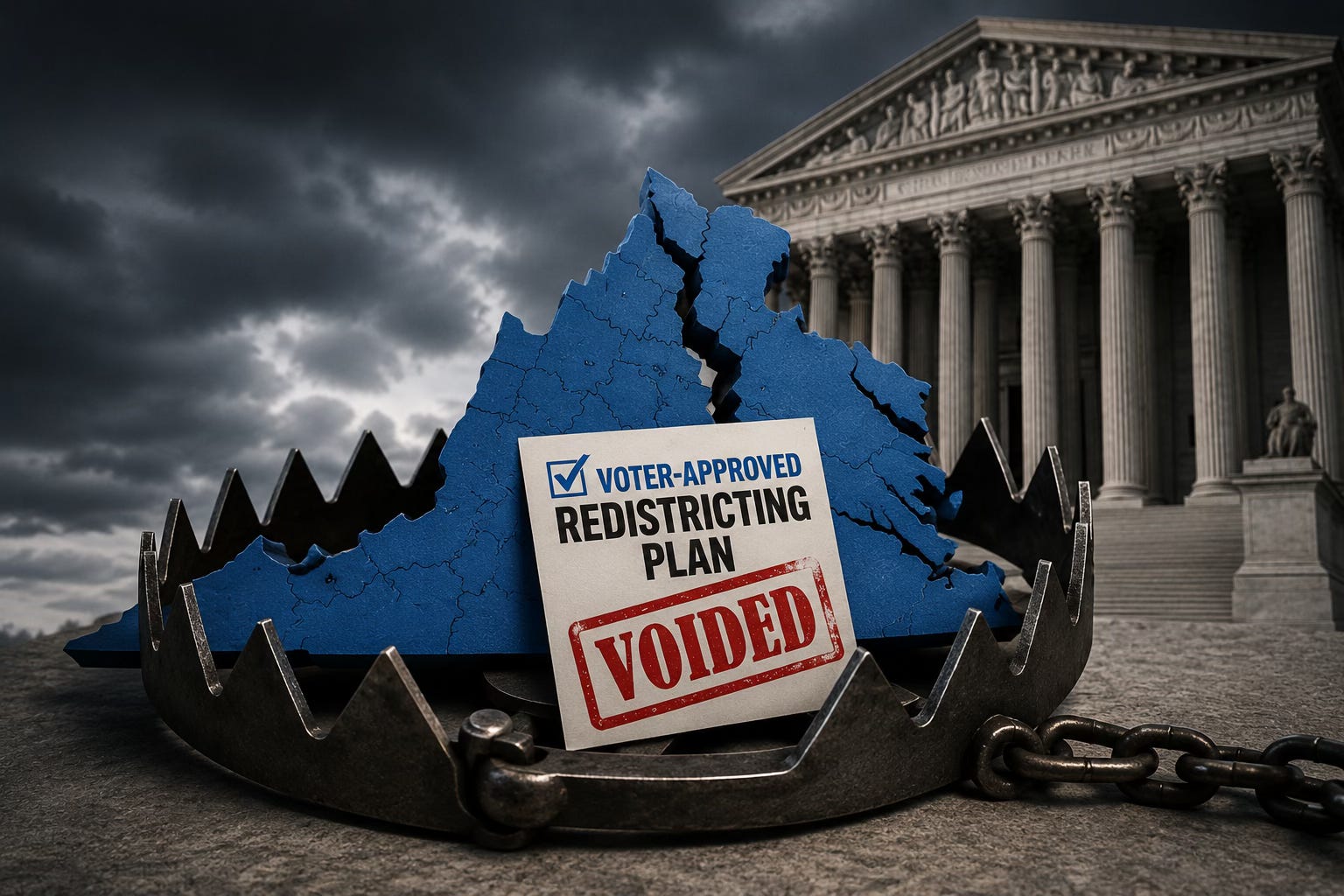
We just heard the heart-breaking news this morning. Here’s what happened and why Virginia Democrats can’t simply do what Republican-led states are doing:
What the Court Ruled
The Virginia Supreme Court struck down the voter-approved Democratic redistricting plan, ruling that the Democratic-led legislature violated procedural requirements when it placed the constitutional amendment on the ballot to authorize mid-decade redistricting. Voters narrowly approved the amendment on April 21, but the ruling renders those results meaningless. The court declared the violation “irreparably undermines the integrity of the resulting referendum vote and renders it null and void.” Spectrum News
Why Virginia Can’t Just Redraw Maps Like Other States
This is the crux of the question, and it comes down to a unique constitutional constraint Virginia created for itself. The case focused not on the shape of the new districts but rather on the process the General Assembly used to authorize them. Because the state’s redistricting commission was established by a voter-approved constitutional amendment, lawmakers had to propose a new constitutional amendment to redraw the districts. ClickOrlando
In other words, Virginia voters in 2020 locked redistricting power inside the state constitution, requiring a multi-step amendment process - not just a simple legislative vote - to change the maps. Republican-led southern states don’t have that constraint; their legislatures can pass new maps through ordinary legislation.
Specifically, a judge found that lawmakers failed to follow their own rules for adding the redistricting amendment to a special session, failed to initially approve the amendment before the public began voting in last year’s general election, and that the state failed to publish the amendment three months before the election as required by law. Wikipedia
The Bigger Picture
Democrats had hoped to win as many as four additional U.S. House seats under Virginia’s redrawn map as part of an attempt to offset Republican redistricting done elsewhere. That ruling, combined with a recent U.S. Supreme Court decision severely weakening the Voting Rights Act, has supercharged the Republicans’ congressional gerrymandering advantage heading into this year’s midterm elections. ClickOrlando
The decision effectively blocks Democrats from redrawing congressional maps mid-decade, after the state spent $5.2 million on the special election and outside groups raised nearly $100 million to sway voters. Axios
So, in short: Virginia is trapped by its own constitutional reform. The very good-government mechanism voters approved in 2020 to create a bipartisan commission is now preventing Democrats from executing the kind of legislative end-run that Republican states can do freely because their legislatures retain direct map-drawing authority.
What this means for Democrats in Virginia and nationally:
In Virginia Specifically
The impact is stark. Democrats’ redrawn map could have resulted in the party representing 10 of Virginia’s 11 congressional districts after the November midterms, up from the current six. That’s four seats gone. The decision effectively blocks Democrats from redrawing congressional maps mid-decade, after the state spent $5.2 million on the special election and outside groups raised nearly $100 million to sway voters. Virginia will instead go into November with the same court-drawn 6-5 Democratic map it currently has. NBC NewsAxios
Nationally - The Redistricting Scoreboard
Before today’s ruling, the map battles were roughly a draw. Until the Supreme Court’s VRA ruling last week, neither Republicans nor Democrats had gained a clear advantage from their revised maps; projected seat gains in some states roughly offset projected seat losses in other states. Now two things have broken badly for Democrats in rapid succession: losing Virginia and the VRA ruling. Council on Foreign Relations
The mid-decade redistricting battles were a draw until Florida jumped in with a new map, giving Republicans a slight edge. The Supreme Court’s decision could yield many more Republican districts than the individual state-by-state battles did. Republicans stand to gain from new House districts passed in Florida, Missouri, North Carolina, Ohio and Tennessee, and could add even more after the VRA ruling, which has prompted some other Republican states to consider redrawing their maps. BrookingsSpectrum News 1
The Bottom Line on House Control
Despite the map disadvantage, Democrats still have a structural tailwind — Trump’s approval ratings. Prediction markets had Democrats at an 83% chance of retaking the House in April 2025, but those odds have since dropped to around 63%, with Republicans rising from 17% to 37% — what looked like a likely Democratic win has become closer to a toss-up, though still slightly leaning Democratic. mediaite
Political science professor Stephen Farnsworth notes that Democrats are “very likely to take over the House,” and that redistricting efforts by both parties will largely cancel each other out — but Republican retirements could also hurt the GOP’s chances of retaining control. iheart
The core tension is this: even with mid-decade redistricting, the public’s assessment of Trump’s job performance will still have a major impact on whether Republicans keep control of the House. Democrats need a net gain of only three seats — a low bar in a hostile political environment for the president’s party — but Republican map-drawing is shrinking the number of competitive seats available for flipping. Council on Foreign Relations
In short, Virginia’s ruling turns what could have been a near-certain Democratic House majority into a genuine nail-biter.
To get reliable, up-to-date voting information, visit TurboVote by Democracy Works.