

They are Turning Government into a Pulpit
From the White House to the Pentagon, Trump’s movement is pushing one strain of Christianity deeper into the machinery of the state.

The constitutional line is not being debated anymore. It is being crossed.
Not by accident. Not quietly. And not in ways we can afford to dismiss as symbolism, trolling, or just another burst of red-meat rhetoric for the base.
It is happening in administration social media. In White House offices. In Pentagon events. In press briefings, interviews, and speeches. What was once packaged as “Christian nation” nostalgia is now being operationalized as governance. The goal is no longer merely to signal religious identity. The goal is to normalize the fusion of sectarian belief with state authority until the boundary itself begins to look optional.
That is the trap.
Because this is not about private faith. It is about public power.
In February, I wrote about the historical fraud at the heart of Christian nationalism: the lie that the United States was founded as a Christian nation and must now be “restored” to that identity. (Project 2025 and the Christian Nation Myth, Feb. 23, 2025). The Constitution was designed to prevent exactly that. The founders did not build a government to enforce theological conformity. They built one to prevent the state from claiming religious truth in the first place. 1
What we are watching now is that safeguard being stress-tested on purpose.
The Myth Moves into Government
This is no longer just a Project 2025 theory problem. It is becoming governing practice.
Trump formally reestablished a White House Faith Office in February 2025 and placed Paula White-Cain, his longtime religious ally, in a senior role. The White House described it as an executive-branch office created by executive order. 2
At the Pentagon, Defense Secretary Pete Hegseth pushed further still. Reuters reported that, in May 2025, he led a “Secretary of Defense Christian Prayer & Worship Service” during the workday inside the Pentagon, had it broadcast internally, and said it would become a monthly event. Reuters also reported that Brooks Potteiger, identified there as Hegseth’s pastor, prayed for Trump at the event. 3
That is not neutrality.
That is not pluralism.
That is not constitutional restraint.
Trump’s own behavior reinforces the pattern. He has repeatedly posted or reposted religiously charged AI images of himself, including as pope and in Jesus-like imagery. Meanwhile, his allies feuded with Pope Leo after the pope criticized the administration’s war posture and the political misuse of religion. 4
These are not random provocations. They are part of a larger spectacle in which Trump is cast, not merely as a politician with religious supporters, but as a leader whose authority is wrapped in sacred imagery and defended in sacred language.
This language did not appear out of nowhere. Business Insider reported in November 2019 that Rick Perry called Trump “the chosen one” and “sent by God,” and that Trump himself had earlier said during the China trade war, “Someone had to do it … I am the chosen one.” What once sounded like grotesque flattery now looks more like a rehearsal for the politics surrounding him today. 5
That spectacle matters because it is backed by real people with real access to power. And, that pattern is not slowing down. This week, Trump is scheduled to read 2 Chronicles 7:11–22 from the Oval Office as part of the April 19–25 “America Reads the Bible” event, a week-long public reading of the entire Bible held in partnership with the Museum of the Bible and involving nearly 500 participants. Organizers said they deliberately reserved that passage for him because of the symbolic weight of 2 Chronicles 7:14, the verse so often invoked in calls for America to return to God and be “healed.” 6
This is not a revival.
It is not religious freedom.
It is the normalization os sectarian power in the state.
Two Paths to the Same Project
Two figures are especially revealing: Brooks Potteiger, the pastor brought inside Pentagon power through Hegseth, and Paula White-Cain, the televangelist restored to formal influence inside the White House.
Their traditions are different.
Their styles are different.
Their routes to power are different.
But they converge on the same destination: a government increasingly comfortable privileging one form of Christianity as a source of legitimacy, authority, and national identity.
Start with Brooks Potteiger.
The scene is the Pentagon: not a church, not a prayer breakfast ballroom, but one of the most powerful military buildings in the world. A workday worship event. A “Secretary of Defense Christian Prayer & Worship Service” broadcast internally while government business continued around it. Reuters reported that Hegseth led the event in May 2025 and brought in Potteiger, his pastor from Pilgrim Hill Reformed Fellowship near Nashville. 7
Potteiger is not a nationally famous celebrity preacher. His influence appears to come not from television fame or a donor empire, but from personal access to one powerful official. That is alarming. It means the religious world entering the Pentagon did not arrive mainly through a media ministry. It arrived through intimacy, trust, and proximity to state power.
A master’s degree in apologetics does not itself mean extremism. Apologetics is formal training in defending Christian doctrine. The degree alone is not the issue.
The issue is the world in which that credential operates.
Pilgrim Hill belongs to the Communion of Reformed Evangelical Churches, or CREC, the archconservative church network the Associated Press linked to Christian nationalism and Christian Reconstructionism. AP reported that Hegseth has publicly embraced that orbit and that the network is associated with patriarchal theology and rigid male authority. 8
That context is important. Potteiger is not simply an ordinary pastor who happened to be invited to a government event. He represents a harder theological-political world, one that sees Christianity not merely as a private faith but as an ordering principle for society.
His path to influence is intimate and direct: one Cabinet secretary, one church network, one public blessing of state power inside the Pentagon. He did not need a television audience. He needed a doorway into power, and Hegseth opened it.
White-Cain’s path is different, but no less revealing.
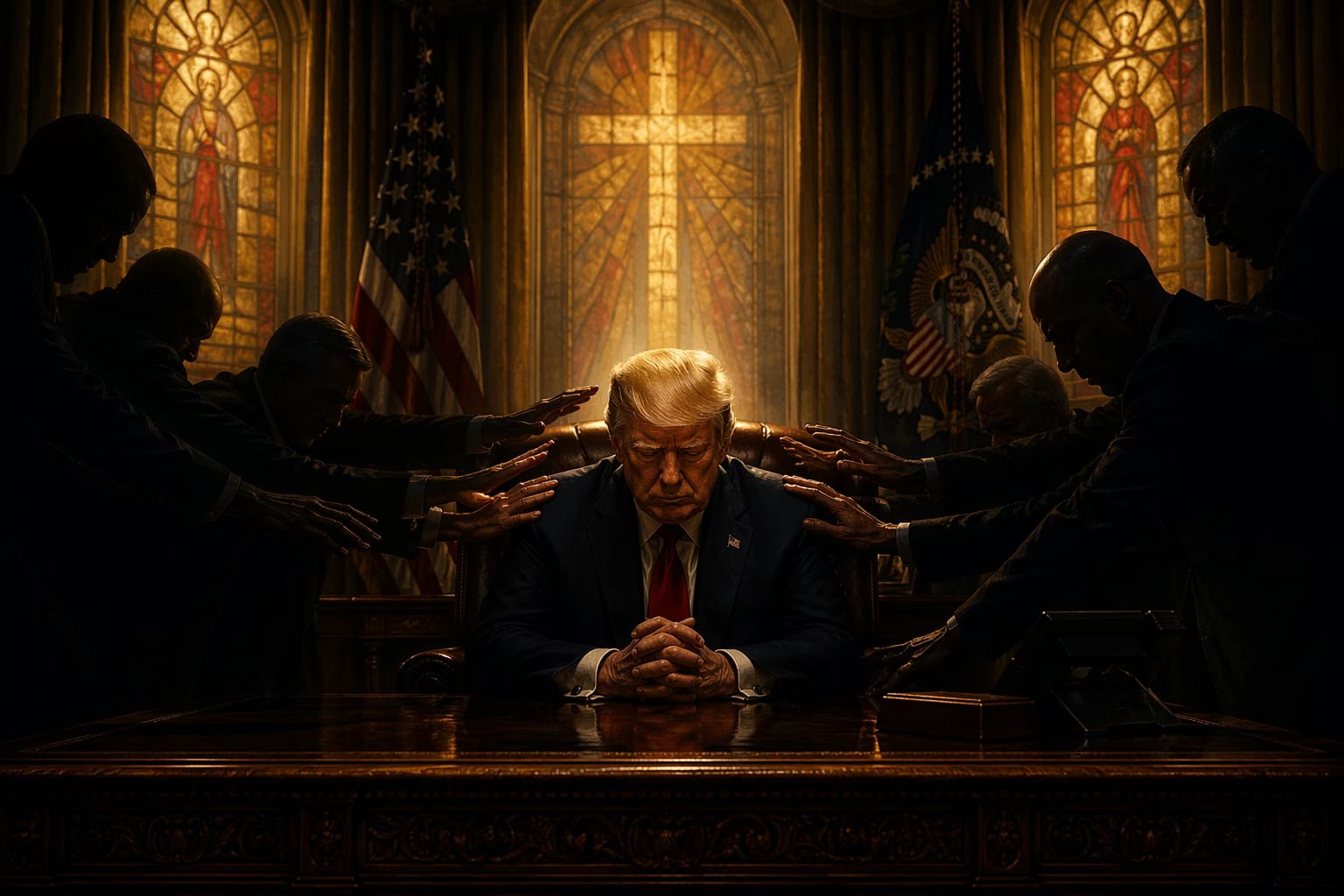
In March, pastors gathered around Trump in the Oval Office while he sat behind the Resolute Desk. Hands were laid on his shoulders. Heads were bowed. Prayers were offered for guidance, protection, and blessing over both the president and U.S. troops. Paula White, who leads the White House Faith Office, was in the room. 9
The White House is not a church. The Oval Office is not an altar. But this administration keeps staging scenes that blur those lines until the distinction itself begins to erode.
Pastors laying hands on a president in the Oval Office is not just a prayer scene. It is a visual argument about who and what sanctifies power.
White-Cain did not arrive there by accident. She built her prominence through televangelism, charismatic ministry, prosperity-gospel branding, and years of proximity to Trump before returning in 2025 to formal influence inside the White House Faith Office. Her influence is not private or symbolic. It now sits within executive power itself.
Different theologies. Same Political Project
That is the heart of it.
Potteiger appears in a Reformed, patriarchal, Reconstructionist-adjacent world that emphasizes authority, hierarchy, and Christian order across all of life. White-Cain comes out of a charismatic Pentecostal-style world shaped by anointing, divine favor, chosen-leader rhetoric, and spiritual spectacle. These are not identical traditions. But Trumpism has become a meeting ground for both because each offers a different route to the same conclusion: that American government should be guided, legitimized, and symbolically possessed by a favored form of Christianity.
One tells followers that Christians must reclaim institutions.
The other tells followers that God raises up chosen leaders for national battles.
One speaks in the language of order, hierarchy, and authority.
The other speaks in the language of prophecy, blessing, and spiritual warfare.
Both can be used to sanctify executive power.
That is why this moment cannot be brushed aside as harmless religious expression. The administration’s defenders will say this is just free exercise, just prayer, just symbolism, just a president who likes attention and supporters who like spectacle.
No.
When government offices are built around favored religious actors, when a defense secretary brings his own pastor into a government worship event, and when presidential performance is increasingly wrapped in sacred imagery, we are no longer talking about private devotion
We are talking about a state increasingly willing to perform religious hierarchy in public.
And hierarchy is the point.
Christian nationalism has always depended on a lie about the founding. But historical fraud was never the endgame. Power was.
The myth of a Christian nation is useful because it turns pluralism into decline, equality into grievance, church-state separation into persecution, and constitutional restraint into an obstacle to be removed. It transforms one group’s hunger for dominance into the language of victimhood and “restoration.”
That is why none of this is trivial.
Not the imagery.
Not the offices.
Not the prayer services.
Not the biblical language wrapped around war and power.
Symbols build legitimacy. Repetition creates normalcy. And once the state begins to speak in the language of one religion, everyone outside that favored framework becomes more conditional in their own citizenship.
The founders understood where that road leads. When the state claims religious truth, dissent becomes disloyalty. Conscience becomes suspect. Power begins to speak in God’s name and punish those who refuse to kneel.
That is the line being tested now.
Not a revival.
Not religious freedom.
The danger is not only that they believe it.
The danger is that they are building it.
Footnotes:
Thank you. This offers a lot of clarity.