

Trump Thinks Wars End When He says They End
The Dangerous Fantasy Behind His Demand for Iran's "Unconditional Surrender"

Trump believes wars end when he says they end. History has never worked that way.
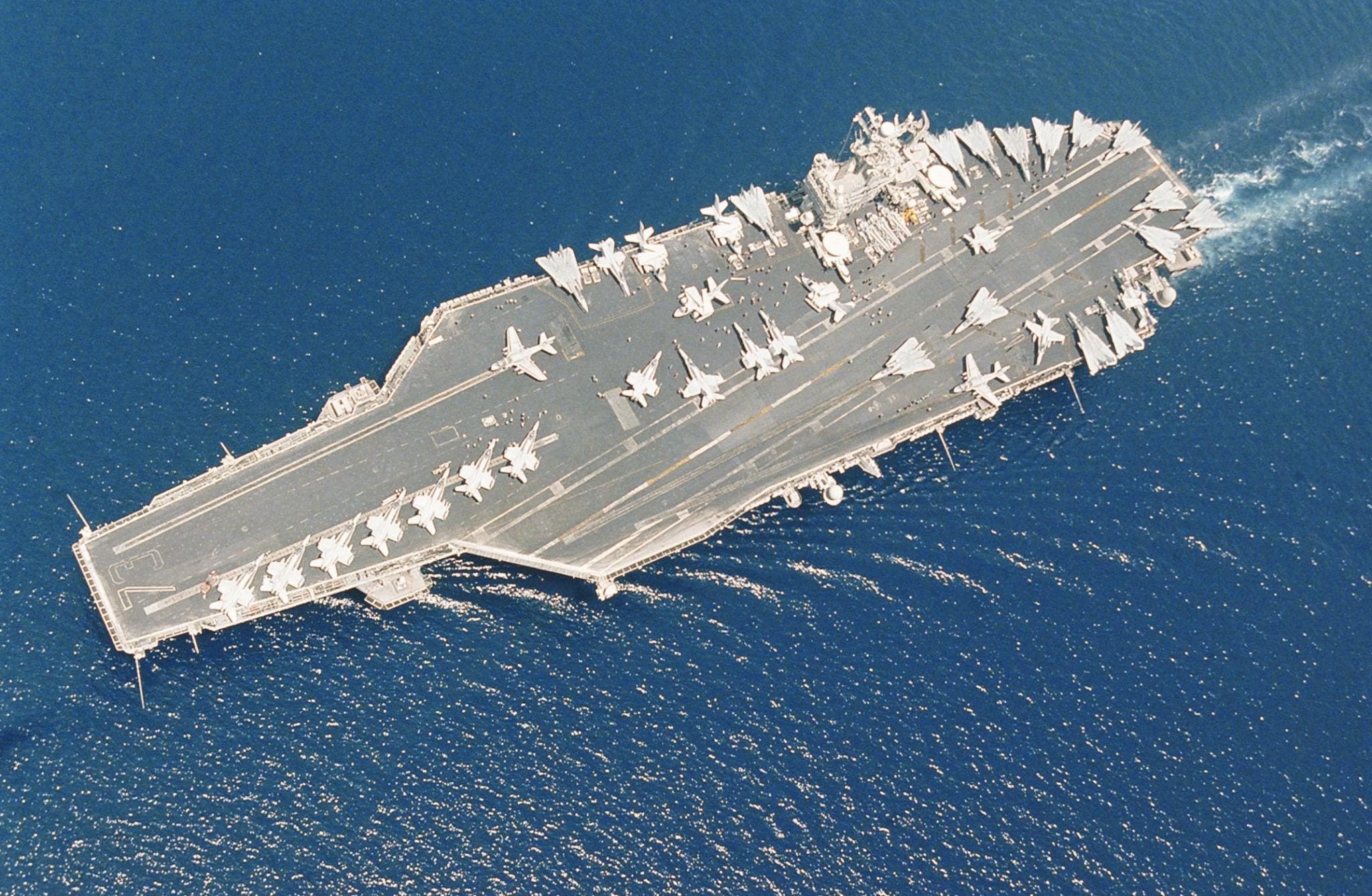
(aircraft carrier USS George Washington)
Editor’s Note: This piece examines recent statement by Donald Trump about the war with Iran and the historical meaning of the phrase “unconditional surrender.” The analysis draws open reporting from NBC News, Axios, Military Times, CNBC, USA Today, CBC, and the historical records from the U.S. State Department and Congressional Research Service.
Donald Trump keeps demanding Iran’s “unconditional surrender.”
He says it the way someone might demand a refund at a hotel desk - as if repeating the words loudly enough makes the outcome inevitable.
But “unconditional surrender” is not a slogan.
It is one of the most extreme demands ever used in warfare. The last time the United States insisted on it, the world was in the middle of World War II and entire governments were about to be dismantled under military occupation.
Trump appears to believe it means something much simpler. That if Iran stops fighting. or if he decides they have stopped fighting, then the war will be over and victory can be declared. History suggests that is not how wars work. And the fact that the President of the United States appears to believe otherwise is more than a rhetorical curiosity.
It is a warning. Now that belief is shaping a war.
Operation Epic Fury
Around March 1, 2026, the United States and Israel launched a large-scale military campaign against Iran known as Operation Epic Fury.
The opening phase of the operation was dramatic.
According to military reporting cited by Military Times, U.S. and Israeli forces struck roughly 2,000 targets inside Iran and destroyed approximately thirty Iranian naval vessels. Officials also reported that Iranian ballistic missile attacks dropped by roughly ninety percent after the first day of the campaign.
Then came the most explosive development of all. Iranian state media later confirmed that Ayatollah Ali Khamenei had been killed in a joint U.S.–Israeli strike. The assassination of the leader of a sovereign state during wartime is an extraordinarily escalatory step - one that historically transforms wars rather than ends them.
But Trump immediately framed the event as the beginning of a political transition he intended to manage. He told reporters that he expected to play a role in selecting Iran’s next Supreme Leader.
That statement alone revealed a breathtaking misunderstanding of Iranian politics, nationalism, and history.
The Phrase Trump Keeps Using
Trump soon escalated his rhetoric further.
Iran, he said, must offer “unconditional surrender.”
The phrase has a specific historical meaning.
It was made famous during World War II when President Franklin Roosevelt announced that the Allied powers would accept nothing less from Nazi Germany and Imperial Japan.
Unconditional surrender meant the complete defeat of the enemy government, the occupation of its territory, and the reconstruction of its political system by foreign powers.
Germany experienced this outcome in 1945. Japan experienced it as well. Outside of those extreme cases, wars rarely end that way.
The Definition Keeps Changing
Trump’s own definition of the phrase appears to shift depending on the interview.
In one conversation with reporters, he suggested that unconditional surrender could simply mean Iran losing the ability to continue fighting “when they don’t have anyone or anything to fight with.”
Soon after, the White House adjusted the definition again. Press Secretary Karoline Leavitt explained that Iran would effectively be considered to have surrendered when Trump determines the country no longer poses a threat to the United States.
In other words, surrender does not require Iran to surrender.
It requires Trump to say they did.
Why Iran Is Unlikely to Surrender
Iran has already rejected the demand outright. Its foreign minister has said the country is not seeking a ceasefire and is prepared even for a potential U.S. ground invasion.
That response reflects political reality. Iran is a nation of roughly ninety million people with a powerful national identity built partly around resisting foreign domination.
It is also one of the oldest continuous civilizations on earth. Persian states existed more than two thousand years before the United States was founded. That long historical memory matters politically. Nations with deep civilizational identities tend to interpret foreign military pressure not as a reason to surrender, but as a reason to resist.
Modern Iranian politics cannot be separated from the 1953 coup, when the CIA helped overthrow Prime Minister Mohammad Mossadegh after he nationalized Iran’s oil industry.
The 1979 Islamic Revolution itself was fueled by resentment toward Western influence. A formal surrender to the United States would be seen inside Iran as a humiliation so profound that any successor government would begin its life politically crippled. Countries built around revolutionary resistance rarely capitulate in that way.
Military historians often note that demands for unconditional surrender tend to prolong conflicts rather than end them, because they remove any incentive for the opposing leadership to negotiate or de-escalate
When Leaders Misjudge How Wars End
History offers many warnings about what happens when leaders misunderstand the limits of military power.
Vietnam is the most obvious example.
For years American leaders insisted that victory was just around the corner if pressure increased slightly more. The United States deployed over half a million troops and conducted one of the most intense bombing campaigns in modern history. The war still ended in withdrawal.
Afghanistan tells a similar story.
The United States toppled the Taliban government within weeks in 2001. But destroying a regime proved far easier than building a stable replacement. The war continued for twenty years before ending in a negotiated withdrawal and the Taliban’s return to power.
Iraq provides another warning.
The 2003 invasion removed Saddam Hussein quickly, but the collapse of the state produced years of insurgency and sectarian conflict.⁹
In each case the initial military success created the illusion that the conflict itself had been solved.
It had not. It had simply entered a different phase.
The People Whispering in His Ear
Trump’s historical ignorance would be dangerous under any circumstances. It becomes more dangerous when paired with advisers who appear to share the same instincts.
Many of the people surrounding Trump today are not seasoned foreign policy professionals. They are political loyalists, media personalities, or ideological allies whose experience lies far from the cautious world of diplomatic strategy.
Defense Secretary Pete Hegseth is a revealing example. Hegseth has frequently presented himself as an enthusiastic advocate of aggressive military action and has suggested that traditional rules of engagement should not constrain U.S. operations.
Rules of engagement are not bureaucratic niceties. They exist to protect civilians, maintain discipline among troops, and prevent actions that escalate conflicts or violate international law. When leaders signal that those rules are optional, the consequences rarely stay theoretical.
Earlier operations in the Caribbean involved U.S. forces destroying small fishing vessels suspected of drug trafficking and, according to reports, without attempts to intercept or detain the crews first. Under normal maritime law, suspected smuggling vessels are intercepted, boarded, and inspected. The people aboard are arrested and prosecuted.
They are not simply blown up at sea.
The Oil Question
There is another layer to this conflict.
Oil.
Iran sits beside the Strait of Hormuz, the narrow waterway through which roughly one-fifth of the world’s petroleum supply normally moves each day. Since the war began, shipping through the strait has largely collapsed as tankers avoid the conflict zone, effectively choking off a major artery of global oil traffic. Energy markets reacted immediately. Oil prices surged above $100 per barrel and spiked much higher at points as traders feared a prolonged disruption to supply.
That kind of shock reverberates through the global economy. Higher oil prices drive inflation, strain national budgets, and reshape geopolitical alliances. But they also produce enormous profits for oil producers.
That does not mean this war was launched for economic reasons. But it does raise an uncomfortable question that rarely appears in official statements. Who benefits from rising oil prices? Because in geopolitics, as in business, incentives matter.
A Familiar Pattern of Power
There is also a broader pattern here.
Project 2025 and the political movement surrounding Trump are built on a theory of executive power that concentrates extraordinary authority in the hands of the president.
Institutions weaken.
Professional expertise is sidelined.
Loyalty becomes the primary qualification for influence.
Foreign policy conducted under that model begins to look very different.
Decisions become more personal.
Goals shift rapidly.
And the guardrails of institutional debate begin to disappear.
War, in that environment, risks becoming something else entirely. Not the carefully weighed decision of a constitutional system. But the impulse of a single leader.
Words Matter
Sometimes the most revealing moments are the smallest ones.
During one recent exchange about the conflict, Trump referred to a military “excursion” when he clearly meant “incursion.”
An excursion is a trip.
An incursion is a military operation in which armed forces enter hostile territory.
On its own, the mistake might seem trivial. But language matters in war.
Military terminology reflects decades of doctrine and legal frameworks governing how armed forces operate. When leaders repeatedly misuse that language, it raises an uncomfortable question.
Is the mistake simply a slip of the tongue? Or does it reveal something deeper; unfamiliarity with the concepts themselves?
And that is where rhetoric collides with reality.
Trump believes wars end when he says they end
History suggests otherwise. Wars end when exhausted soldiers stop fighting, when economies buckle under the strain, or when political realities force leaders to accept outcomes they once insisted were impossible.
They end slowly, painfully, and often in ways no one predicted at the beginning.
History has ended many wars. None of them ended because a president declared victory at a press conference.
If this piece helped clarify what’s happening, consider restacking it so others can read it too. Clear information travels only when readers carry it.
Sources
Military Times reporting on Operation Epic Fury and early strike results.
U.S. State Department Office of the Historian – Casablanca Conference and the Allied demand for unconditional surrender.
Axios reporting on Trump’s comments redefining “unconditional surrender.”
USA Today reporting on White House press secretary statements regarding surrender definition.
NBC News reporting on statements from Iran’s foreign minister regarding ceasefire and invasion readiness.
U.S. State Department historical record on the 1953 Iranian coup and Mossadegh overthrow.
https://mohammadmossadegh.com/news/us-state-department/iran-documents/
U.S. National Archives – Statistical information on the Vietnam War.
Congressional Research Service – U.S. Military Operations in Afghanistan, 2001–2021.
Congressional Research Service – The Iraq War: Background and Issues for Congress.
CBC reports on “Cascading effects’ of Strait of Hormuz blockage.