

Project 2025 and the Christian Nation Myth
The Constitution Was Designed to Prevent Exactly This

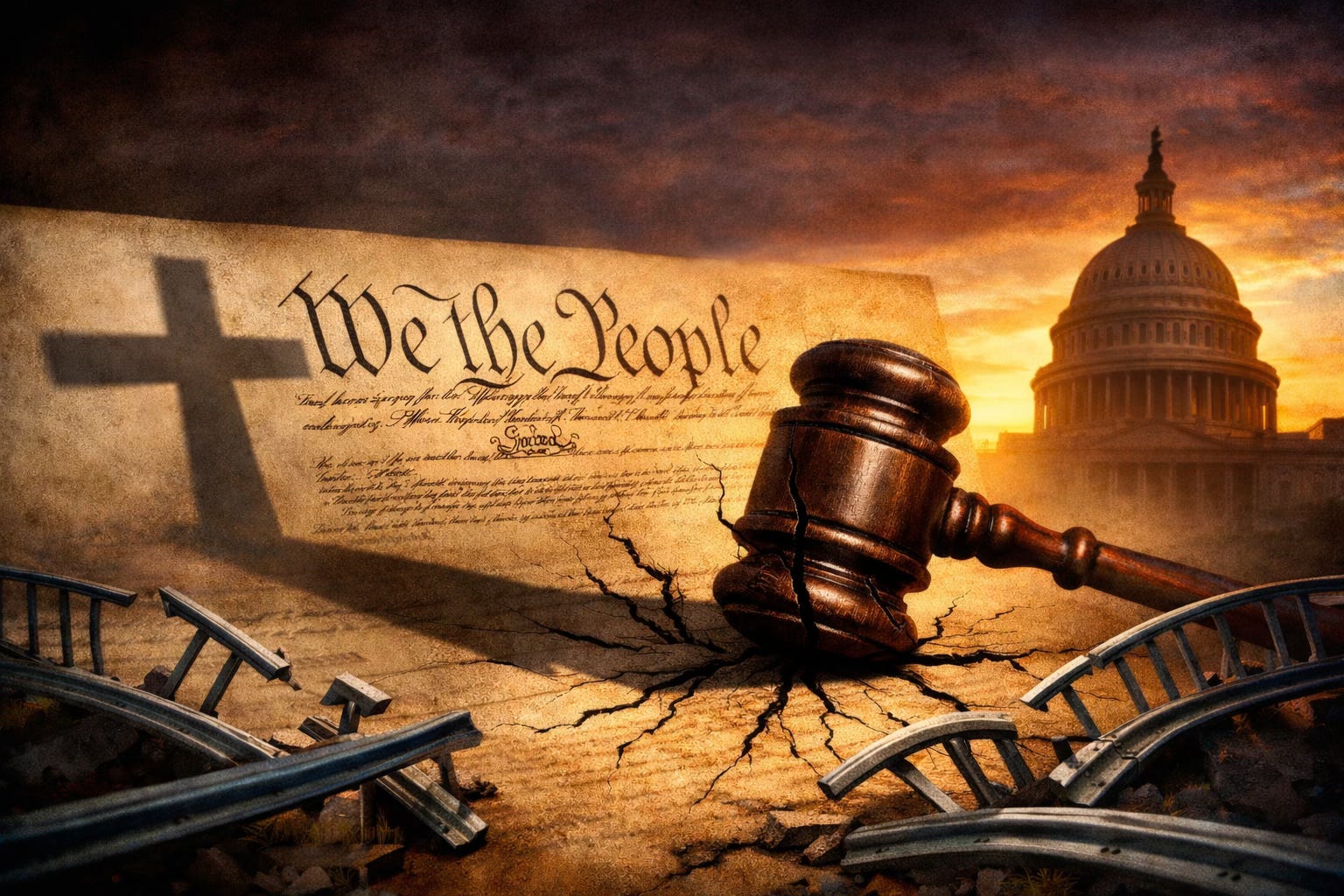
A powerful historical rewrite is underway.
For months in this Substack, I have traced how Project 2025 seeks to consolidate executive power, purge institutional independence, and reengineer federal governance. But beneath the bureaucratic blueprints lies something even more consequential: a theological claim about the nation itself.
Project 2025 is not merely a plan for administrative restructuring. It is animated by the belief that the United States was founded as a Christian nation - and that restoring that identity requires reshaping the Constitution - in practice if not in text.
That claim demands a history lesson. Because if we are going to watch constitutional guardrails bend in real time, we should at least know what they were built to prevent.
The Founding Design: Enlightenment, Not Theocracy
The founding generation lived in the Age of Enlightenment, when debates about conscience, reason, and religious coercion were central to political thought. Many founders were influenced by Deism, generally believing in a Creator but skeptical of church authority, miracles, and state-enforced doctrine. They leaned on reason and natural law more than revelation.
Others were personally religious, some devout. But the constitutional system they built together was intentionally nonsectarian - a structure designed to prevent any national church from capturing the machinery of government.
The founders were united on one crucial principle: civil rights and public office do not hinge on religious orthodoxy. Government has no authority to declare theological truth.
The design was written plainly into law
Article VI of the Constitution declares that “no religious test shall ever be required as a Qualification to any Office or public Trust under the United States.” That single line bars the federal government from conditioning political authority on membership in any faith. 1
The First Amendment reinforces the same structure: “Congress shall make no law respecting an establishment of religion, or prohibiting the free exercise thereof.” 2
In other words, the federal government has no mandate to choose a favored church, enforce doctrine, or reserve citizenship for people with approved beliefs.
The 1797 Treaty of Tripoli makes the point unusually explicit. Ratified unanimously by the Senate and signed under President John Adams, it states that “the government of the United States of America is not in any sense founded on the Christian Religion.” 3
Thomas Jefferson’s Virginia Statute for Religious Freedom declares that civil rights do not depend on religious opinion and forbids compelled support for religious worship. 4 In his 1802 letter to the Danbury Baptists, Jefferson described the First Amendment as building “a wall of separation between Church & State.” 5
James Madison’s Memorial and Remonstrance argued that religion is a matter of reason and conviction, “wholly exempt” from civil authority. 6
George Washington, writing to the Hebrew Congregation in Newport in 1790, declared that the government of the United States “gives to bigotry no sanction, to persecution no assistance.” 7
This is not vague rhetoric. It is constitutional architecture. The founders did not build a Christian state because they had watched Christian states punish dissenters. They deliberately constructed guardrails.
Departure, Not Defense
Today’s “Christian nation” and increasingly “white Christian nation” rhetoric is not a defense of the founding. It is a departure from it. It seeks to replace constitutional equality with religious gatekeeping. It reframes pluralism as decline. It recruits history as propaganda to make theological hierarchy sound inevitable.
If “real Americans” must be Christians - and the “right” kind of Christians - then religious liberty ceases to be a constitutional right held by everyone and becomes a privilege granted to favored groups.
From Blueprint to Power
This is not an academic debate. Christian Nationalist architects of Project 2025 now hold federal authority. 8
Russell Vought, a principal architect of the Project 2025 framework, has written about the need for government rooted in a distinctly Christian understanding of national identity. As a federal budget director, he influences which programs are expanded, defunded, or dismantled — including immigration enforcement, detention infrastructure, and civil rights oversight.9
Stephen Miller, another architect of the Project 2025 agenda, has shaped immigration policy through rhetoric centered on demographic preservation and civilizational threat - language long associated with white Christian nationalist ideology. 10
The executive branch now operates a White House “Faith Office,” formalizing religious outreach within executive governance. Members of Congress increasingly use prayer events not merely as private observance, but as political alignment signals. 11
“In a move that pushes the boundaries of Constitutional prohibition against a state religion, Defense Secretary Pete Hegseth hosted an evangelical prayer service in the middle of the day at the Pentagon in which a pastor praised President Donald Trump as "sovereignly appointed." A program for the event called it the "Secretary of Defense Christian Prayer and Worship Service." It was held at the Pentagon's auditorium and was broadcast throughout the building on its internal cable network. 12
When senior defense officials encourage or normalize sectarian gatherings within the armed forces, then religious pressure enters one of the most constitutionally sensitive institutions in American life. This is not symbolism. It is proximity to power.
When religious identity becomes intertwined with enforcement authority, budget machinery, immigration policy, and executive structure, the constitutional guardrail against religious establishment is no longer theoretical. It is being stress-tested in real time.
How Erosion Happens
The Constitution does not vanish overnight. It erodes. First, religious language becomes policy framing. Then policy preferences become enforcement priorities. Then dissent becomes recast as hostility to faith.
If national belonging is defined through religious identity, millions of Americans — Jewish, Muslim, Hindu, Sikh, atheist, Catholic, evangelical, or simply the “wrong” kind of Christian become conditional participants in their own country. Pluralistic democracy narrows.
Church-state fusion does not produce moral clarity. It produces hierarchy. And hierarchy enforced by the state is no longer faith. It is power.
A Line That Cannot Be Crossed
The founders understood something simple and dangerous: when the state declares religious truth, dissent becomes disloyalty. That is why they refused to fuse church and government.
If the machinery of federal authority is guided by an ideology that insists America must be reclaimed for one faith, one cultural lineage, one civilizational identity, then exclusion will not remain rhetorical. It will be enforced.
That is not revival. It is state-backed identity hierarchy. That is not a culture war. It is a constitutional crisis unfolding in plain sight.
Christian Voices Rejecting Christian Nationalism
It is both historically inaccurate and theologically misleading to treat Christian nationalism as synonymous with Christianity. Many Christian leaders and organizations argue the opposite: that Christian nationalism is a political ideology that distorts the Christian faith and threatens constitutional democracy.
Christians Against Christian Nationalism, a campaign founded in 2019 by Amanda Tyler of the Baptist Joint Committee for Religious Liberty, defines Christian nationalism as “a political ideology that seeks to merge Christian and American identities - distorting both the Christian faith and America’s constitutional democracy.” 13
The campaign emerged in response to increasing violence against houses of worship by white supremacists and the growing fusion of religious rhetoric with nationalist politics. Its statement of principles emphasizes that “America has no second-class faiths” and calls on Christians to reject Christian nationalism as a corruption of the gospel and a danger to pluralistic democracy.
As of February 22, 2026, the campaign reports dozens of affiliated local groups across multiple states and a growing network of Christians committed to defending both religious freedom and constitutional order.
This matters. Because the defense of church-state separation is not hostility toward Christianity. It is a defense of the Christian conscience as well as the Jewish conscience, the Muslim conscience, the atheist conscience — every conscience.
When faith is fused with state power, faith itself becomes political currency.
Resistance
The answer is not hostility toward religion.
It is fidelity to the Constitution. It is insisting that citizenship carries no religious test.It is defending the principle that government does not adjudicate theology. It is protecting the full and equal standing of every American under law.
We do not need a state religion. We need civic courage. That means naming historical revisionism when we see it.
Showing up at school boards and city councils when sectarian instruction is proposed.
Calling and writing representatives when enforcement power is misused.
Supporting faith leaders who reject Christian nationalism.
Refusing to normalize rhetoric that equates religious identity with national worth.
The American experiment was not designed to enforce theological conformity. It was designed to protect freedom of conscience. Those guardrails were built deliberately, and they are now being tested deliberately.
History is not only something we teach. It is something we defend. And this moment demands that we do exactly that.
Footnotes:
This one is especially good, Jeri. I especially appreciate it you discussing the distinction between Christianity and Christian nationalism. I also think your ideas for actions that everyday citizens can perform was great. It's easy to become overwhelmed with despair at what's happening, and providing doable and common sense action items is really needed!
Check out the clothing line Essentials Fear of God. I cracked up lol at the sheep that fall for that stuff.