

Project 2025's Real-World Test
The Bill of Rights is the firewall. Trump's enforcers are trying to burn it down

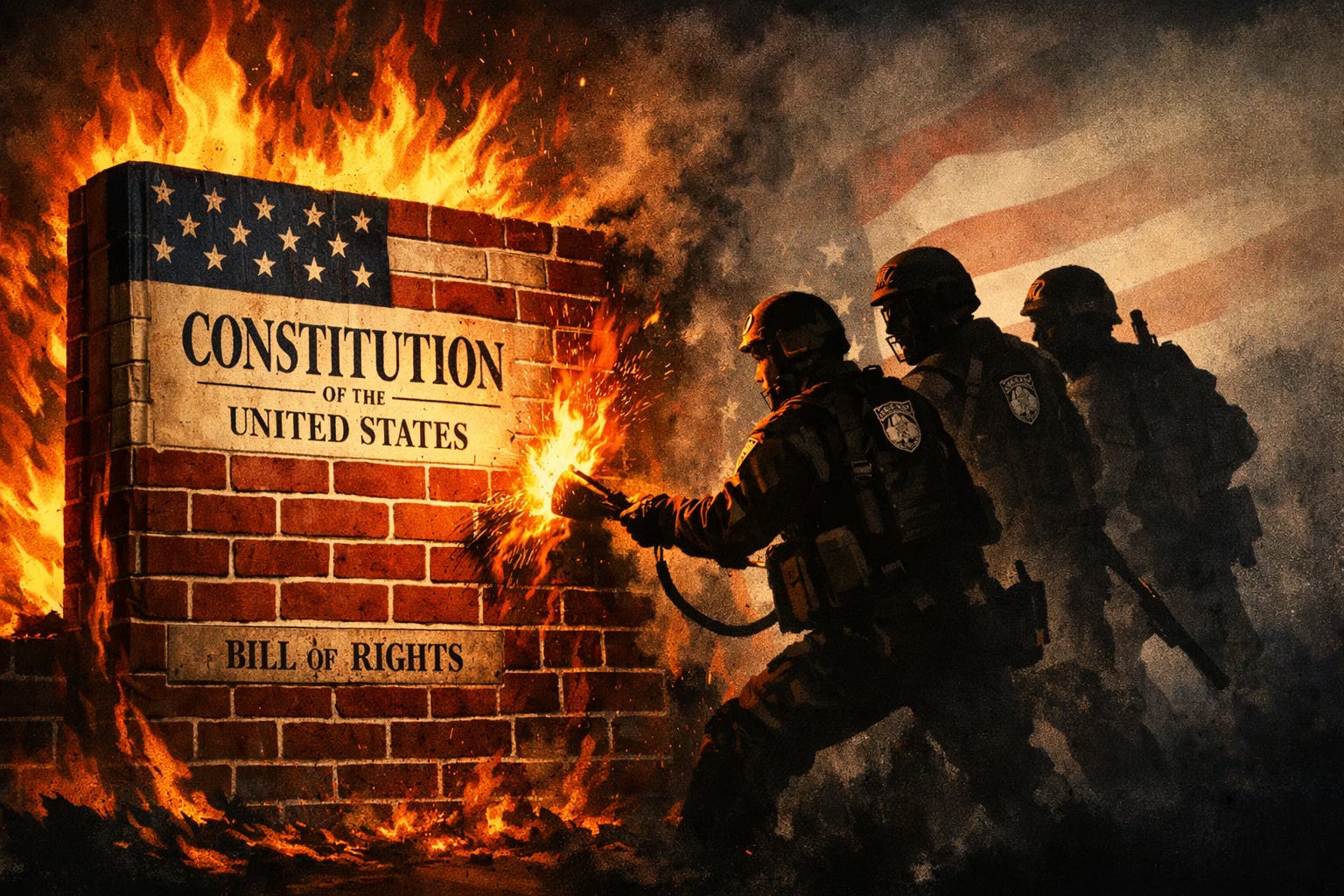
“A republic, if you can keep it.” Benjamin Franklin’s famous reply at the close of the Constitutional Convention (September 17, 1787) is often repeated like a patriotic bumper sticker. But it was never meant to be comforting. It was a warning: a republic survives only if ordinary people stay informed, stay engaged, and refuse to surrender their rights out of fear, exhaustion, or blind loyalty. 1
Instead, the years since January 6, 2021 have delivered the opposite lesson. Rather than rejecting the authoritarian impulse on display that day, millions of voters brought the racist, corrupt criminal back to power. In the four-year gap between his two terms, Christian Nationalist power networks had time to regroup and refine their blueprint. Stephen Miller and Russell Vought sharpened Project 2025’s “Mandate for Leadership,” recruited loyalists, and prepared to treat the next presidency, not as a public trust, but as a takeover. They also fully expected Trump to win.
I have written many SubStacks about how the Christian Nationalist Project 2025 is supplanting our Constitution and reshaping the United States into a theocratic authoritarian plutocracy - one where “rights” become whatever Trump and his enforcers decide they are. My Nov. 11 post, Before the Cross Replaces the Constitution goes further, tracing the history and the intentional overlap between the Christian Nationalist “Seven Mountains” doctrine and Project 2025’s plan of action. I won’t repeat the details here, but I have included the link above for new subscribers and for anyone who wants a refresher.
So here we are.
Trump has not yet been in office for a year, and the damage is already measurable. Laws are treated as optional. Oversight is mocked. Institutions are hollowed out. The machinery of government is increasingly used not to serve the public, but to punish opponents, intimidate communities, and reward allies. If you’re watching closely, the pattern is hard to miss: this isn’t “mismanagement.” It’s a plan.
And it’s working in part because too many Americans don’t know what the Constitution actually guarantees.
One subscriber messaged me recently to say that our citizenry is woefully ignorant of basic constitutional rights. I agree. Naturalized citizens are required to study civics and pass a test; many end up with a clearer understanding of our system than people born her who were never taught it well. Meanwhile, civics education is inconsistent nationwide. The American Bar Association reports that only 37 states require a standalone high school civics course (31 require a one-semester course; 6 require a full-year course). 2
If you don’t know what you are legally entitled to, you won’t recognize when it’s being taken away - or how quickly “normal” can be rewritten.
Authoritarian regimes are especially skilled at declaring the unlawful “lawful,” then daring the public to believe official talking points over their own eyes. The killing of Renee Nicole Good in Minneapolis is a brutal example. DHS officials claimed the ICE agent shot her in self-defense and said he was taken to the hospital with internal bleeding; yet, reporting describes surveillance video showing Good turning her wheels and trying to drive away from the agents as the shots were fired. 3Minnesota’s Bureau of Criminal Apprehension also publicly stated it withdrew from investigating after the U.S. Attorney’s Office reversed course and the FBI took sole control - leaving the state without the access it said it needed for a thorough, independent review. 4
This is the new environment: force first, narrative second, accountability later - or never!
WHAT ARE OUR RIGHTS AND WHO GETS THEM?
The first ten amendments to the Constitution—the Bill of Rights—exist for one reason: to protect the people from government abuse and to require fair treatment, even when the government is angry, afraid, or politically motivated.
A key point: these protections are not limited to citizens. The Constitution repeatedly uses “the people” and “persons.” Many of the strongest protections—especially due process—apply to everyone inside the United States, though the details can shift at the border and in certain immigration contexts.
If you want to read the full text, you can:
Order a pocket Constitution from the UCLA ($10) 5
Buy the official pocket edition from the the U.S. Government Publishing Office Bookstore ($2) 6
Read the full texture free online at the National Constitution Center 7
THE BILL OF RIGHTS, IN PLAIN ENGLISH
First Amendment: Protects freedom of religion, speech, the press, peaceful assembly, and the right to petition the government.
Second Amendment: Protects the right to keep and bear arms.
Third Amendment: Bars the government from forcing people to house soldiers in their homes in peacetime without consent.
Fourth Amendment: Protects against unreasonable searches and seizures; generally requires a warrant based on probable cause.
Fifth Amendment: Protects due process, bars double jeopardy and forced self-incrimination, and requires compensation when the government takes private property for public use.
Sixth Amendment: In criminal cases, guarantees a speedy public trial, an impartial jury, notice of charges, confrontation of witnesses, compulsory process, and the right to counsel.
Seventh Amendment: Preserves the right to a jury trial in many federal civil cases.
Eighth Amendment: Prohibits excessive bail, excessive fines, and cruel and unusual punishment.
Ninth Amendment: Says that listing certain rights doesn’t erase other rights the people retain.
Tenth Amendment: Reserves powers not delegated to the federal government to the states or the people.
WHAT IT LOOKS LIKE WHEN DHS PUSHES PAST THE LINE
Below are reader-friendly examples tied to specific reporting, lawsuits, and court orders. In many cases these are allegations; in others, judges have already issued injunctions or settlements restricting DHS conduct.
FIRST AMENDMENT: SPEECH, PRESS, ASSEMBLY—RETALIATION AND INTIMIDATION
A federal court in Southern California issued a preliminary injunction restricting DHS conduct toward journalists, legal observers, and protesters after evidence that DHS used crowd-control force and targeted people engaged in protected activity. 8
In Minnesota and Illinois, the states sued the Trump administration to halt or restrain a DHS “surge,” alleging unconstitutional tactics including excessive force and racial profiling, and seeking basic accountability measures like visible identification and limits on face-concealing masks. 9
In a Minnesota federal court hearing, DOJ argued there is no First Amendment protection for “observing police,” in a case tied to alleged retaliation and intimidation of people monitoring immigration agents. 10
FOURTH AMENDMENT: STOPS, ARRESTS, HOME TACTICS, AND SURVEILLANCE
A federal judge in Colorado issued a preliminary injunction restricting ICE warrantless arrests, requiring not only probable cause of an immigration violation but also probable cause that the person is likely to flee before a warrant can be obtained. 11
In Southern California, a settlement in Kidd v. Noem prohibits ICE from impersonating local/state police or using other deceptive ruses to enter homes or lure residents outside—tactics that corrode consent and Fourth Amendment protections. 12
The ACLU published FOIA-obtained documents describing DHS components buying access to sensitive location data from private brokers—an end-run around the warrant process that turns commercial surveillance into government power. 13
FIFTH AMENDMENT: DUE PROCESS—CONDITIONS AND ACCESS TO LAWYERS
A federal court issued a temporary restraining order over abusive conditions at 26 Federal Plaza in New York, requiring ICE to improve hygiene and access to medical care and to ensure people can make free, confidential calls to lawyers within 24 hours. 14
In Los Angeles, a federal court granted a preliminary injunction after evidence that detainees held at the B-18 site were cut off from meaningful attorney access—denied phone lines, turned away from in-person meetings, and pressured to sign documents before speaking to counsel. 15
SIXTH AMENDMENT REALITY CHECK: WHEN THE RIGHT TO COUNSEL “ATTACHES”
The Sixth Amendment applies to criminal prosecutions; much DHS enforcement is civil immigration enforcement, where the legal fight is often framed as due process and statutory rights rather than a guaranteed government-provided attorney. But the “denied a lawyer” pattern still matters. One high-profile example: a naturalized U.S. citizen, Wilmer Chavarria, sued after CBP detained him for hours and pressured him to hand over electronic devices—part of a broader legal clash over warrantless digital searches and access to counsel during detention. 16
EIGHTH AMENDMENT (AND DUE PROCESS): PUNITIVE, DANGEROUS, DEGRADING CONFINEMENT
Senator Jon Ossoff’s October 2025 oversight report describes 85 credible reports of medical neglect and 82 credible reports of denial of adequate food or water in immigration detention, including cases reportedly leading to life-threatening complications. 17
In Florida’s “Alligator Alcatraz” litigation, AP reported a detainee’s attorneys said he was coerced into signing an English-only “voluntary removal” form he didn’t understand, amid broader criticisms of limited legal access and poor tracking/oversight at the facility. 18
If any of this feels surreal, that’s part of the design. When power wants to break the law openly, it first needs a public that doesn’t recognize the law it’s breaking.
Franklin’s warning wasn’t about memorizing patriotic phrases. It was about maintenance. A republic isn’t “kept” by faith. It’s kept by informed citizens who know what the Constitution says, who recognize coercion when it’s rebranded as “public safety,” and who refuse to let any administration—of any party—convert rights into privileges granted only to the obedient.
Because once the government can ignore the Constitution for “them,” it never stays with “them.” It comes for “you.”
Footnotes: