


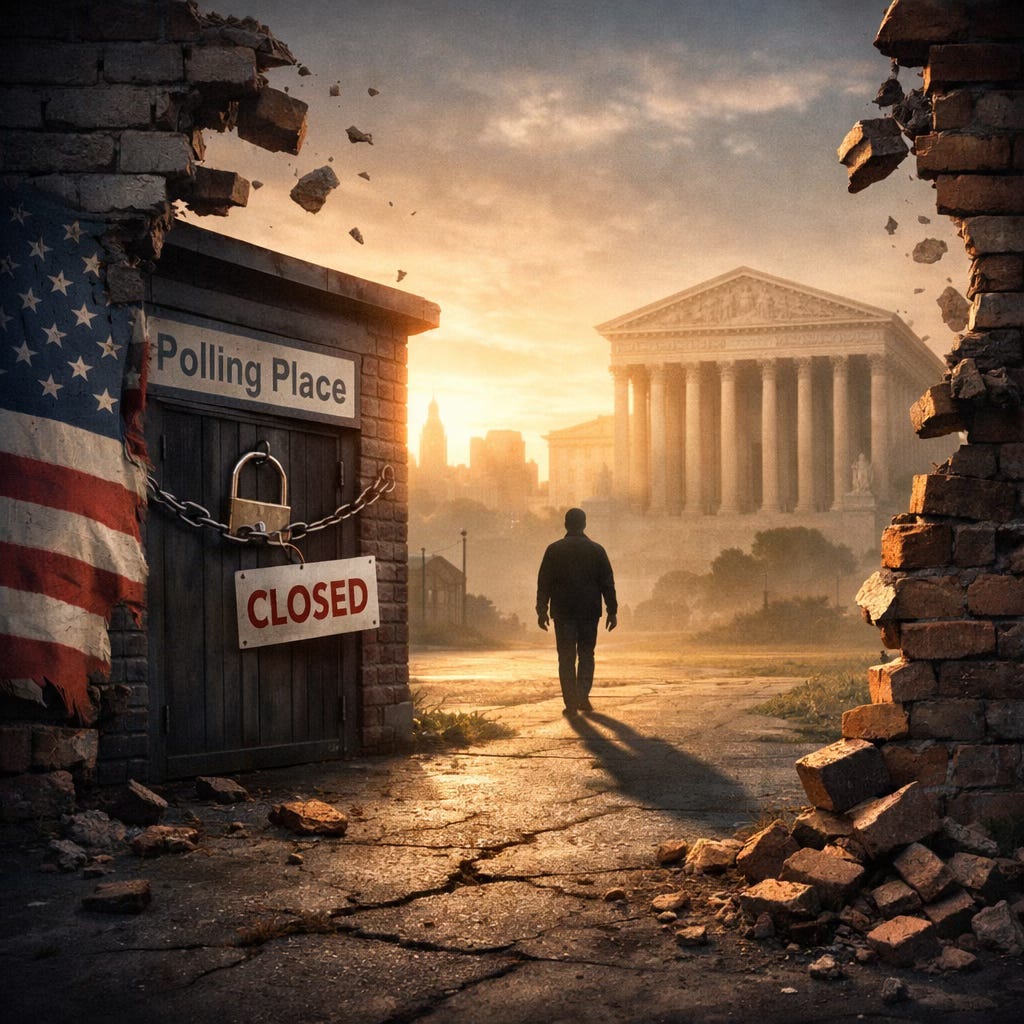
There was once a firewall built into American democracy - a system designed to stop discriminatory voting laws before they ever reached voters. When the Supreme Court dismantled that protection, it didn’t just change election law; it changed who carries the burden of protecting the right to vote.
There can be no democracy without the right of every citizen to vote without prejudice. That right rarely disappears in one dramatic moment. It erodes in small administrative decisions most people never see; a polling place moved, a district line redrawn, an ID rule tightened - each one small enough to defend, but powerful enough to shape who gets heard.
I learned what voter suppression looks like long before I ever read a Supreme Court opinion about it. I saw it standing on a street in Houston in 2018, canvassing for Beto, holding a clipboard and a list of voters who wanted to participate in their democracy - if they could.
Primary voters told us where they had voted earlier that year. Churches. Schools. Community centers. Familiar places they had used for years. So that’s where they planned to go on Election Day. That’s what they trusted.
Except when Election Day came, many of those locations weren’t voting sites anymore.
The new locations weren’t always far as the crow flies. But Harris County is enormous. If you work hourly, if you rely on a ride, if you’re voting between shifts, if you have kids in tow - “not far” might as well be impossible. And many voters didn’t even know the location had changed until they showed up to vote and found locked doors or a sign pointing somewhere miles away.
When I asked why there hadn’t been clearer notice, I was told - quietly, matter-of-factly - that confusion was part of the point. That moving locations could shave turnout in communities already facing transportation barriers, work schedule constraints, and long lines.
I can’t prove what was in anyone’s heart when those decisions were made. But I saw the result. I saw voters who wanted to participate in democracy lose their window to do it.
I didn’t understand then that there had once been a system designed to stop exactly this kind of change before Election Day ever arrived.
For decades, there was a federal backstop designed specifically to stop exactly that kind of last-minute election change. Under the Voting Rights Act, jurisdictions with a documented history of racial discrimination in voting couldn’t just move polling places, redraw districts, or change voting procedures and hope no one noticed. They had to prove, in advance, that the change would not harm minority voters. 1
That process was called preclearance, and it flipped the burden where Congress believed it belonged: on governments with a history of discrimination, not on individual voters scrambling to fight back after an election was already over.
What Preclearance Actually Stopped
Alabama
Preclearance blocked multiple redistricting plans that would have diluted Black voting power in majority-Black areas. It also blocked changes that would have reduced minority electoral influence by splitting communities across districts.
Texas
Preclearance initially blocked Texas’s 2011 voter ID law after courts found it would disproportionately burden minority voters. It also blocked redistricting maps found to weaken Latino and Black representation. 2
Georgia
Preclearance blocked polling place changes and election rule changes in several counties where federal reviewers found minority voters would be disproportionately affected.
Mississippi
Preclearance blocked attempts to weaken minority voting strength in local election district changes.
Louisiana
Preclearance locked redistricting and voting rule changes that risked diluting Black voting strength in parishes with documented discrimination history.
When the Supreme Court’s Shelby County v. Holder decision gutted the formula that made preclearance possible, it didn’t just strike a line of statutory text. 3 It shifted the country from a system designed to prevent discrimination before ballots were cast to one that forces voters to prove discrimination after their votes have already been diluted, delayed, or denied. 4
Once you understand that shift, moments like Houston stop looking like isolated confusion and start looking like exactly the kind of scenario pre-clearance was built to prevent.
If the pre-Shelby Voting Rights Act system had still been fully functioning, Harris County would not have been able to simply change voting locations and let voters discover the change on Election Day. Because Texas was one of the states covered by the Voting Rights Act oversight system, local officials would have had to submit the change to the federal government first. They would have had to explain why the change was happening, who it would affect, and - most importantly - prove it would not make voting harder for minority communities.
Federal lawyers would have reviewed data:
How many voters used the old location?
Who lived nearby?
Was public transportation available to the new site?
Would the change increase wait times or travel distances in neighborhoods with large minority populations.
If federal reviewers believed the change risked suppressing minority voting, they could block it before it ever touched an election. Voters would never show up to locked doors. Campaign volunteers would never be scrambling on Election Day trying to redirect people across a county the size of a small state.
That is what the “formula” made possible. It told the federal government where to look - where history showed discrimination had been repeated enough times that extra review was justified. Without that formula, the review system didn’t just weaken. It stopped operating entirely.
So, when I stood in Houston helping voters figure out where they were supposed to go, I wasn’t just seeing local election logistics. I was seeing what voting rights enforcement looks like when it happens after the fact instead of before. I was seeing the real-world version of what happens when the burden shifts from government proving fairness to voters trying to prove discrimination after they’ve already lost their chance to vote.
Since the Shelby decision, partisan map manipulation and restrictive voting policies have accelerated in many states. In many cases, legislatures now draw districts designed to protect incumbents or dilute opposing voting blocs, often affecting communities of color that tend to vote Democratic. 5 At the same time, repeated claims of widespread illegal voting by undocumented immigrants have been made by influential politicians, including by our president and members of Congress, despite a lack of evidence showing large-scale noncitizen voting. 6 These claims are often used to justify restrictive voting laws or aggressive enforcement proposals that risk intimidating lawful voters. 7
The John Lewis Voting Rights Advancement Act - legislation designed to restore modernized preclearance protections - failed by just two votes in the Senate in 2021. 8
That failure wasn’t just legislative gridlock. It was the moment the country chose, at least for now, to live without the firewall that had protected voting rights for generations.
A firewall only works if it exists before the fire starts. For nearly half a century, the Voting Rights Act forced governments with histories of discrimination to prove their voting changes were fair before they could reshape an election. When that protection was dismantled, the burden shifted to voters; to recognize suppression, to fight it in court, to overcome it in real time. If we want a democracy where the right to vote is protected instead of negotiated, the firewall must be rebuilt. And that will only happen if voters demand it - at the ballot box, in their communities, and from the people they send to Congress.
Thank you for this wonderful post. I know there will be interference with the midterms. And the moving of polling places was one I hadn't previously thought of. Such a simple act but how subversive.