

The Line, the Cliff, and the Lie
How an Obsolete Poverty Line, a Billionaire Government, and a Broken Safety Net Abandon 75% of American Households

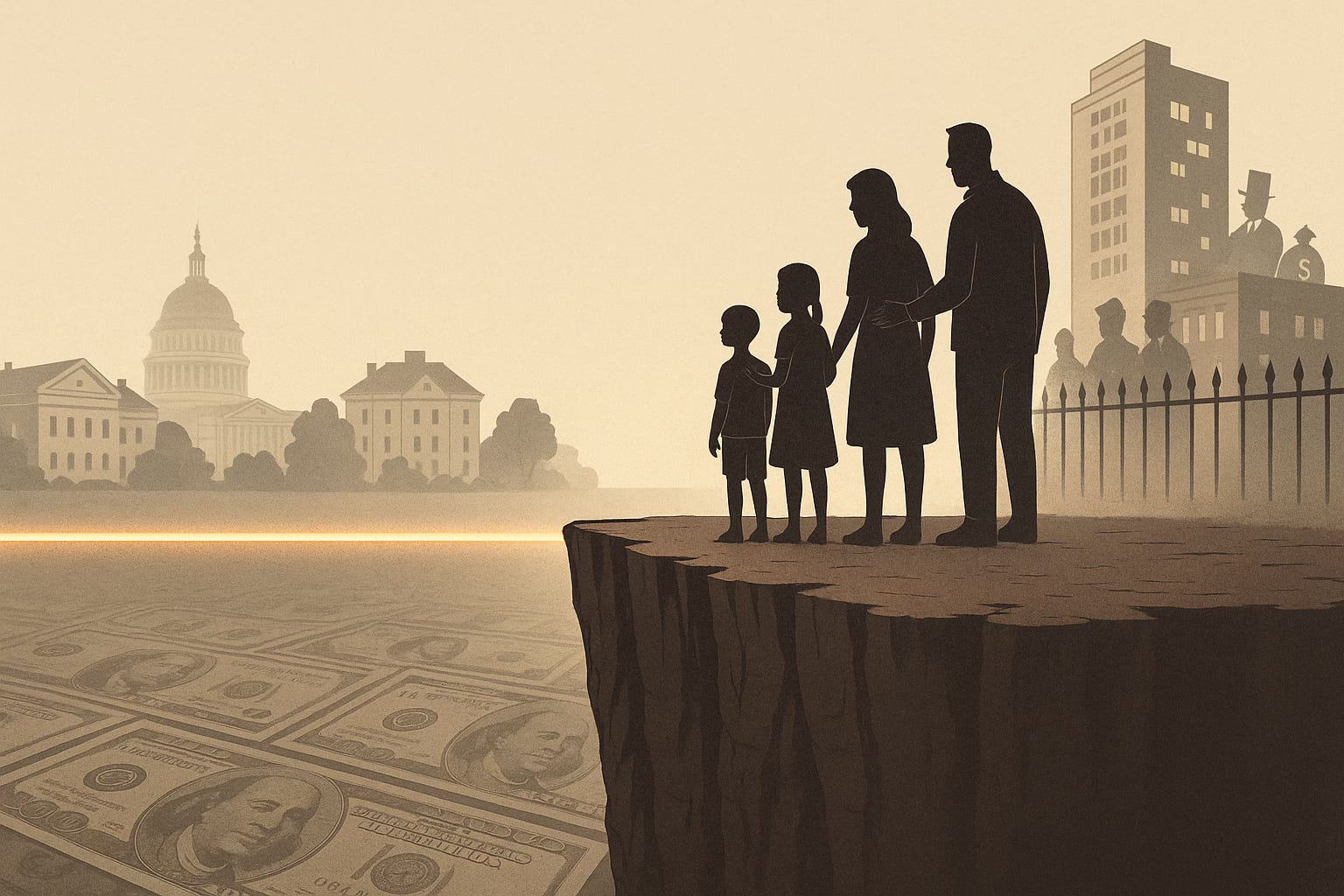
The number that decides whether your kids get school lunch, whether you qualify for Medicaid, food stamps, WIC, housing assistance, and more is not some finely tuned measure of need. It’s a 1960s shortcut: three times the cost of a bare-bones “thrifty” food plan, adjusted only for inflation. 1 Most of us have never heard of that formula, let alone the woman who created it. But since 1963, Mollie Orshansky has quietly shaped who “counts” as poor in America and who gets told, on paper, that they’re doing just fine. 2
Mollie Orshansky, who grew up hungry in a Bronx tenement as the daughter of poor Ukrainian Jewish immigrants, never set out to write scripture. She was a government number-cruncher trying to turn her own memories of standing in relief lines into a simple, usable tool for policymakers. Her poverty thresholds were meant to be “arbitrary but not unreasonable” yardsticks—a way to count who clearly didn’t have enough to live on so the government could stop guessing. She assumed future officials would adjust and improve them as costs, family budgets, and social programs changed. 3
Instead, even after her death in 2006, the rough food-based formula has remained in place, a piece of invisible infrastructure still running in the background - still shaping who “counts” as poor, long after the woman who designed it has been forgotten.
Before 1963, there was no official federal poverty line at all. Each program had its own rules, and local offices had a lot of discretion. Assistance was patchy and often moralistic. Aid to Dependent Children (later AFDC) was a means-tested cash grant for families where the father was “dead, absent, or unable to work.” Caseworkers had wide latitude to decide whether a mother’s home and personal life were “morally fit” and often used their discretion to push Black women and unmarried mothers off the rolls. 4 By creating a clean, national poverty line, Orshansky helped shift eligibility guidelines from arbitrary and local to formulaic and universal. It was a significant improvement - just never updated to match the world we actually live in now.
Even inside government, people know the original measure is flawed. That’s why the Census Bureau now also publishes a Supplemental Poverty Measure (SPM) that tries to account for taxes, non-cash benefits like SNAP, and actual housing costs. The SPM usually shows a higher poverty rate than the old line—around 12–13 percent of Americans in recent years, compared with roughly 10–11 percent under the official measure. 5 When temporary pandemic supports were allowed to lapse, the child SPM poverty rate nearly tripled to about 13 percent in just a few years. 6 But, here’s the catch: the SPM is just a statistic. The outdated, food-times-three formula is still the one embedded in law and used to gate-keep who gets help.
What “the safety net” looked like in my house:
Long before Washington settled on an official poverty line, families like mine were already living inside its blind spots. I grew up with a single mom and three siblings, dirt poor. We didn’t talk about “AFDC” or “means-tested assistance.” We talked about “going down to the office” and “praying they say yes this time.”
One of my clearest memories is the government surplus food we called “commodities.” Big cardboard boxes with whatever the government happened to have too much of: tinned mystery meat, powdered eggs, powdered milk, blocks of cheese the color of road cones, and peanut butter so dense it could bend a spoon. There was no sense that some neat formula in Washington had decided we were poor enough for this food. It felt more like the local office decided whether we were “deserving” this month.
Later, around 1967 or 1968, my mother got into a program we knew only as WIN. It was the first time the safety net felt like more than just barely keeping us alive. WIN (Work Incentive Program) came with child care so she could be in class, help with housing so we weren’t constantly on the brink of moving, and support for her to go to school for her LPN. For the first time, assistance wasn’t just about handing us boxes of leftover food; it was about helping my mother earn a credential and step out of the welfare office for good.
When Mollie Orshansky was quietly building her poverty thresholds in the early 1960s, this was the world she was trying to measure: families standing in commodity lines, mothers begging caseworkers for help with the rent, children being shuffled so their mom could take a shot at training. Her line turned lived chaos into a number policymakers could not ignore—at least on paper. But for people like my mother, the system still felt arbitrary and personal. We weren’t poor because a chart said so; we were poor because we could taste it in the powdered milk and feel it every time a caseworker had the power to say no.
Fast-forward to now.
In 2020, the federal poverty line for a family of four was $26,200. 7 Five years later it’s $32,150. 8The line inches up each year from automatic inflation adjustments, but it is still anchored to that original food-times-three formula with no real consideration of modern costs like housing, child care, student debt, or health care—the costs that actually break families today.
Then I stumbled across a SubStack article that completely changed how I think about poverty and our so-called safety net. Michael W. Green is a Wall Street investor and Chief Strategist and Portfolio Manager at Simplify Asset Management. 9 He argues that the real poverty level in the United States is not around $32,000 for a family of four, but an astonishing $140,000. His argument is essentially a household budget laid out in cold daylight: what it actually costs, line by line, for a family to cover housing, transportation, food, child care, health care, debt, and a small cushion for emergencies in today’s economy.
Green is usually described as a market theoretician and portfolio manager, not as a statistician or poverty scholar. And that’s the point: his “$140,000 poverty line” isn’t coming from some graduate seminar on measurement. It’s the judgment of someone who looks at real household budgets and says, bluntly, “Below this level, you are not secure.” You may be working full-time. You may look “middle class” on paper. But you are one broken car, one illness, one rent hike away from collapse. 10
Here’s how he describes the difference between 1963 and now:
“For 1963, that floor made sense. Housing was relatively cheap. A family could rent a decent apartment or buy a home on a single income, as we’ve discussed. Healthcare was provided by employers and cost relatively little (Blue Cross coverage averaged $10/month). Childcare didn’t really exist as a market—mothers stayed home, family helped, or neighbors (who likely had someone home) watched each other’s kids. Cars were affordable, if prone to breakdowns. With few luxury frills, the neighborhood kids in vo-tech could fix most problems when they did. College tuition could be covered with a summer job. Retirement meant a pension income, not a pile of 401(k) assets you had to fund yourself.”
Meanwhile, our policies still behave as if that world exists:
When policy analysts say families up to 130–180 percent of the poverty line qualify for “some” help, what they really mean is that even households well above the official poverty line still can’t make it on their own. In today’s dollars, that’s roughly $40,000–$60,000 a year for a family of four. Program rules reflect this: free school meals generally cut off around 130 percent of the line and reduced-price meals around 185 percent, while SNAP and other key benefits often use thresholds between 130 and 200 percent of poverty. 11 Census and policy data suggest that roughly a quarter of Americans live below twice the poverty line, and on the order of 30 million people are stuck in that murky 130–180 percent band: too “rich” to be officially poor, too broke to be secure. 12
Here is what that looks like in real life:
A single mother takes a better-paying job and gets a modest raise that nudges her just above the cutoff for child-care assistance and Medicaid. On paper, she is doing better; officially, she no longer “needs” help. In reality, she loses her subsidy, pays hundreds more a month for child care and health insurance, and ends up with less disposable income than before. The poverty line says she has been lifted out of need. Her bank account says otherwise.
By contrast, if you take Michael Green’s claim seriously and treat roughly $140,000 as the true poverty line for a family of four, then about three-quarters of all U.S. households suddenly count as “poor” by that standard. Census income tables show that only the top slice of households—roughly the upper fifth—earn more than that. 13 The official line says poverty is a niche problem at the bottom. The way benefits actually phase out—and the way families really live—suggests it stretches deep into what we like to call the middle class.
Politicians like to act as if this is all an abstraction, but it isn’t. If you compare pay over time, you can see exactly whose reality Washington’s numbers do and don’t track. 14 Congressional salaries have been frozen at $174,000 since 2009, which means lawmakers have effectively taken a one-third pay cut in real terms as prices rose. 15 The median full-time worker has seen wages creep up a bit, but nowhere near enough to match the cost of housing, health care, child care, and debt. 16 At the top of the pyramid, CEO pay has exploded—up more than tenfold in real terms since the late 1970s—pushing the typical CEO-to-worker pay ratio into the hundreds. 17On paper, a member of Congress now makes only two to three times what a median worker earns. But from the vantage point of a household scraping by at 130 or 150 percent of the poverty line, both Congress and the C-suite live in another galaxy entirely.
That gap has consequences. When Congress shovels money to the wealthiest people in the country, when the Trump administration openly enriches itself and its billionaire sycophants while canceling health care and food programs for the poorest families and dismantling what little is left of the middle-class ladder, it is not a policy disagreement. It is a choice about whose reality counts. A poverty line designed as a temporary stopgap in the 1960s has hardened into an excuse: if you’re above that line, the system insists you’re fine, no matter what your rent, your child-care bill, or your grocery receipt says.
We should be furious that a measure meant to make poverty visible is now being used to make struggle disappear. And we should be even more furious that Congress has allowed a self-serving executive to treat the “power of the purse” as a personal slush fund for the already rich. If three-quarters of American households are living below the line it actually takes to be secure, that is not a fringe problem. It is the country. It is us.
At minimum, we must demand two things: that Congress reclaim its constitutional power over the budget from an out-of-control presidency, and that it finally drags our official poverty measure into the reality most Americans are living in - not the world of 1963, and certainly not the world of Mar-a-Lago, where an autocrat leader presides over elaborate parties and complains that affordability is a hoax.